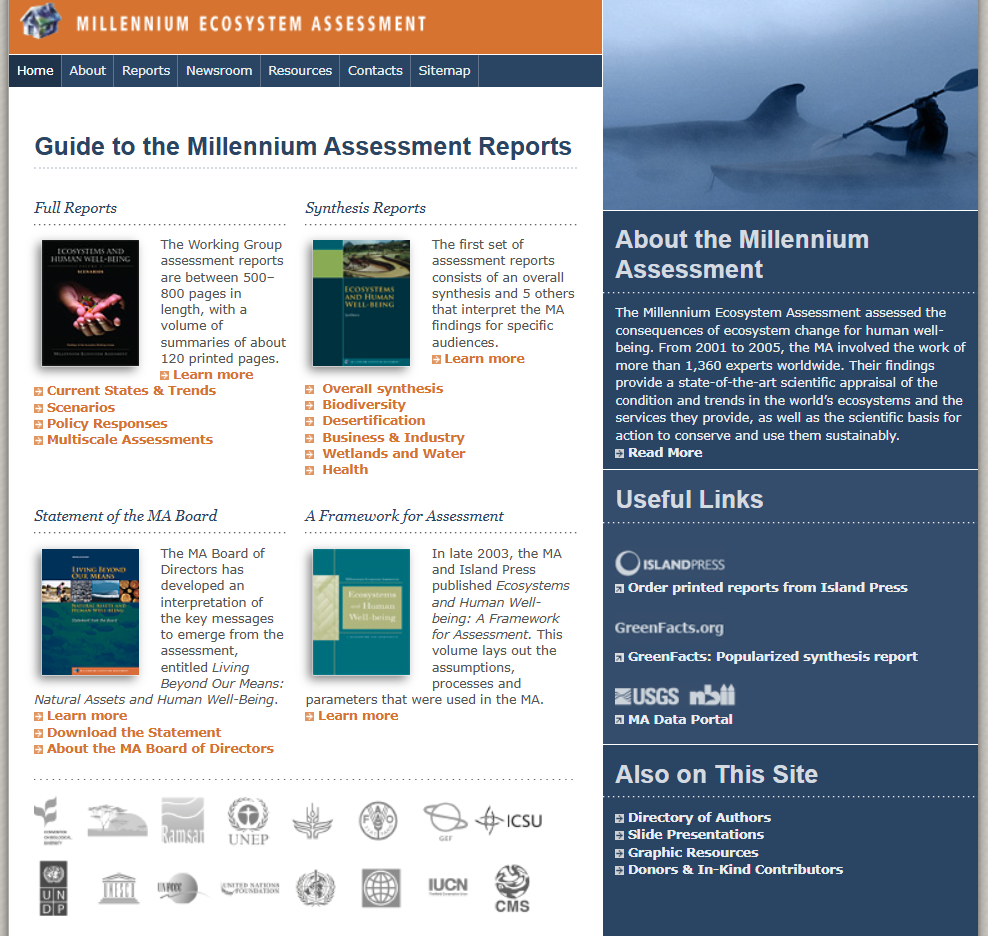
Featured image credit: Product by the Millennium Ecosystem Assessment / World Resources Institute, source: Millennium Ecosystem Assessment
The Millennium Ecosystem Assessment (MEA) was a major global study that examined how ecosystem change affects human well-being. It was launched in 2001 and published in 2005, and it became one of the most influential assessments in environmental policy and research.
What the MEA Was
The MEA was created to assess the consequences of ecosystem change for people and to provide a scientific basis for better decisions about conservation and sustainable use. It involved more than 1,300 contributors from around 95 countries, which made it one of the most comprehensive international environmental assessments of its time.
The assessment was developed under the broad call of UN Secretary-General Kofi Annan and was designed to answer practical questions about the state of the world’s ecosystems and their links to human well-being. Its findings were published in several volumes and synthesis reports that covered trends, scenarios, and response options.
Why It Was Important
The MEA was important because it changed how policymakers and researchers talk about nature. It helped popularize the idea of ecosystem services, meaning the benefits people receive from ecosystems such as food, water, timber, fuel, climate regulation, and disease control.
It also delivered a powerful message: humans have changed ecosystems more rapidly and extensively in the past 50 years than at any other comparable period in history. Those changes have improved human well-being in some ways, but they have also caused major losses in ecosystem services and increased risks for future generations.
Main Findings
One of the MEA’s key conclusions was that ecosystem degradation is closely tied to human activity and economic development. The assessment found that while some people benefited from ecosystem changes, others faced increased poverty, vulnerability, and environmental decline.
It also warned that degradation of ecosystem services could worsen and become a barrier to development goals if not addressed. At the same time, the MEA showed that many problems could be reduced or reversed through better policies, institutions, and practices.
Long-Term Impact
The MEA had a lasting effect on environmental policy, planning, and research. It provided a strong baseline for later work on biodiversity, natural capital, and nature-based solutions.
Its influence can still be seen in modern climate and ecosystem policy, where the links between ecological health and human well-being are now widely accepted. In that sense, the MEA helped move the global conversation from “protect nature” to “protect nature because human societies depend on it”.
Why It Still Matters
The MEA remains relevant because the pressures it identified have only intensified in many parts of the world. Climate change, biodiversity loss, land conversion, pollution, and water stress continue to affect ecosystems and the services they provide.
For that reason, the MEA is still used as a reference point in environmental policy and education. It remains a landmark example of how science can shape global understanding and public decision-making.