Advancing research
Conferences
2024
Circular Economy Stakeholders Conference
The EU Circular Economy Stakeholder Platform (ECESP) has been a successful initiative to accelerate the transition to a circular economy. Discover the challenges overcome and how the initiative successfully offers a wealth of best practices for policy makers, businesses, academia and civil society, and translates dialogue into cooperation. The aims, structure and deliverables of the platform will be illustrated by those who make it work: two EU institutions and 24 representatives of the ECESP’s Coordination Group.


2022
CULTADISER
The project aims to develop UAUIM’s capacity to support research in architecture and urbanism by creating a culture of dissemination of results, bringing together a series of representative actions for research in the field, from doctorates as the spearhead of scientific research in architecture and urbanism to the results of studies carried out by teachers and researchers.
2021
INNOMINCU
The “Ion Mincu” University of Architecture and Urbanism, through the project INNOVATION as Necessity, Opportunity and Registered Trademark of University Research (INNOMINCU), co-financed by CNFIS-FDI 2021, carries out activities aimed at stimulating performance in research, development and innovation activities, as well as improving the research skills of the main actors of the university environment: teaching staff, researchers, doctoral candidates and students. We also aim to establish collaborative relationships with public and private institutions, as well as carry out experimental projects, scalable at the university level, in order to increase visibility and institutional prestige at national and international levels.


2016
RRRC
This paper, presented at an international conference, marked the beginning of my second year of doctoral studies (November 4, 2016) and was written in English. The work explores the perspective of reinterpreting architectural elements in an ecosystemic manner, adapting buildings to the surrounding natural environment, or rather, enhancing it, increasing its value through multifunctional interfaces, with functions similar to biological systems (like ecosystem services), or simply carriers of intentional, premeditated, cultivated, designed natural capital.
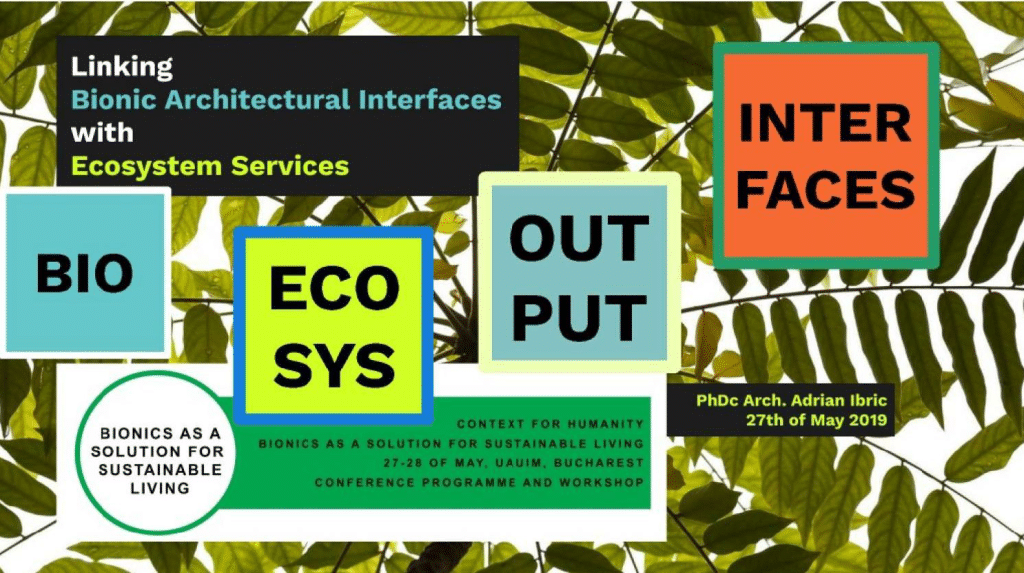
The latest series of doctoral events I attended was the workshop and conferences: “Context for Humanity – Bionics as a Solution for Sustainable Living,” coordinated by Prof. Dr. Arch. Rosa Cervera, University of Alcala de Henares, Spain – in Bucharest (May 27-28, UAUIM) and Tulcea (May 29-31, Vernacular Center), organized by UAUIM through the Doctoral School of Architecture and the Faculty of Interior Design, together with the Tulcea City Hall and the Context for Humanity Association (Tulcea).

The “European Symposium on Diversity in Sustainable Development” was a series of events on sustainability in architecture and urbanism organized by UAUIM together with UAR, ASTR (Romanian Academy of Technical Sciences) and WREN (World Renewable Energy Network) between 11-13 April 2016 in Bucharest, benefiting from presentations by foreign architects such as Wolf Prix, Marco Sala, Henning Saltzer among others.
Stay Connected with Us