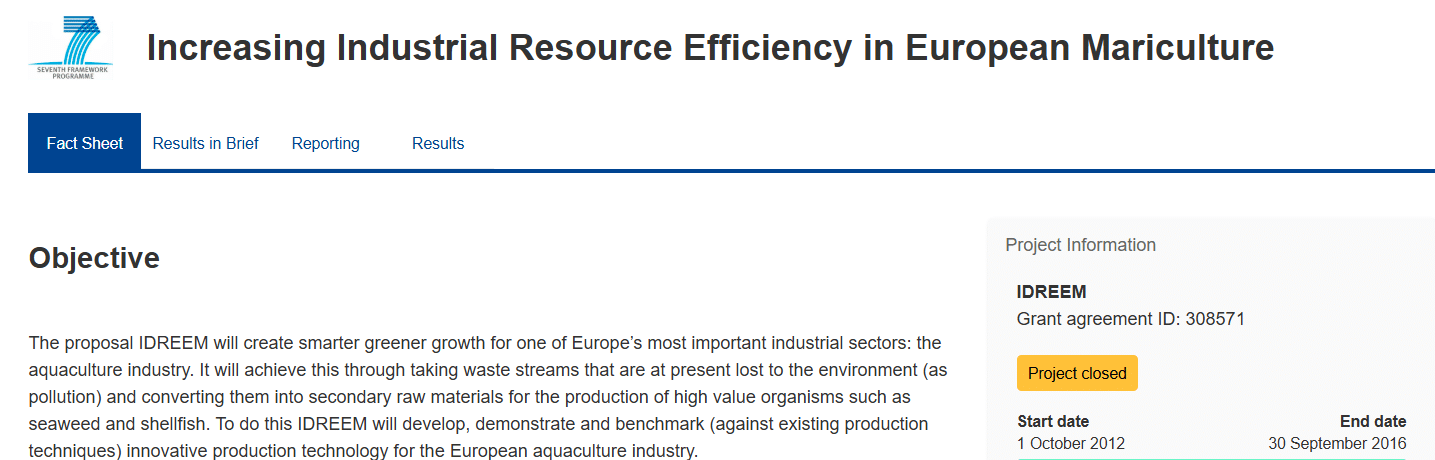
The IDREEM project (Increasing Industrial Resource Efficiency in European Mariculture) was an ambitious European Union research initiative funded under the Seventh Framework Programme (FP7) (Grant Agreement No. 312143). Its primary mission was to transform European aquaculture from traditional, single-species operations into highly efficient, circular ecosystems.
Traditional finfish farming often faces a fundamental resource challenge: a significant portion of the nutrients supplied via fish feed can end up lost to the surrounding marine environment as metabolic waste or uneaten food, potentially leading to issues like localized eutrophication (Carballeira Braña et al., 2021). The IDREEM project was designed to tackle this bottleneck head-on by scaling up Integrated Multi-Trophic Aquaculture (IMTA) across Europe (Kleitou et al., 2018).
Shifting from Monoculture to Circular Mariculture
The core philosophy of IMTA is simple: turn one species’ waste into another species’ food. Instead of farming a single species in isolation, IDREEM developed and tested systems that combine different species from varying levels of the food chain (trophic levels) into a shared commercial space (Kleitou et al., 2018; Knowler et al., 2020):
- Fed Aquaculture (The Primary Input): Finfish species (such as salmon, sea bass, or sea bream) are given commercial feed, generating organic particulate waste (feces and uneaten pellets) and dissolved inorganic nutrients (nitrogen and phosphorus) (Carballeira Braña et al., 2021; Knowler et al., 2020).
- Organic Extractive Species (The Particle Filters): Shellfish (like mussels, oysters, or clams) are deployed downstream to filter out and consume the suspended solid waste particles (Kleitou et al., 2018).
- Inorganic Extractive Species (The Nutrient Absorbers): Macroalgae (seaweeds like kelp) act as natural biofilters, absorbing the dissolved nitrogen and phosphorus directly from the water column to power their own growth (Kleitou et al., 2018).
Core Project Scope & Key Deliverables
IDREEM brought together a consortium of scientists and commercial aquaculture enterprises to move IMTA from a theoretical concept to an industrial reality by delivering outcomes across three main pillars:
1. Commercial-Scale Pilots
The project established real-world pilot systems across distinct European eco-regions (including the Atlantic coast and the Mediterranean). These pilots proved that cultivating fish, seaweed, and shellfish in close proximity is operationally viable at an industrial scale, helping to establish best-practice guidelines for farm layouts and hydrodynamics (Kleitou et al., 2018).
2. Bio-Economic Modeling
A major barrier to commercial adoption has always been financial uncertainty. IDREEM developed advanced bio-economic tools to model how introducing extractive species changes a farm’s bottom line. The models demonstrated that while IMTA adds operational complexity, it provides financial protection through product diversification—giving farmers alternative revenue streams if fish market prices drop (Knowler et al., 2020).
3. Market Readiness & Eco-Labeling
The project extensively studied consumer perceptions and market pathways. Research indicated a strong public willingness-to-pay a premium for seafood certified under sustainable practices like IMTA, provided there is a clear, transparent eco-labeling framework to back up environmental claims (van Osch et al., 2019).
Interactive IMTA Efficiency Simulator
To visualize how transitioning from a standard monoculture to an optimized IMTA system can capture lost nutrients and create new revenue streams, adjust the parameters in the tool below.
The Long-Term Challenge: Despite the clear ecological benefits proved by projects like IDREEM, widespread commercial adoption in Europe still faces hurdles. Rigid regulatory frameworks, complex multi-species licensing processes, and a lack of unified policy definitions often make it difficult for traditional monoculture farmers to transition permanently to full IMTA systems (Kleitou et al., 2018).