Source:ECOWAMA CORDIS Project Sheet|ECOWAMA CORDIS Results in Brief
The Surface Treatment of Metals and Plastics (STM) industry is a cornerstone of modern manufacturing, applying protective galvanic coatings to components used in everything from electronics to aerospace engineering. However, these processing operations are traditionally resource-intensive. Every year, European coating facilities generate more than 300,000 tonnes of hazardous chemical waste and consume greater than 100 million cubic meters of fresh water.
The resulting industrial effluents are heavily contaminated with toxic organic materials, processing oils, high salinity fractions, and dangerous heavy metals like dissolved nickel, zinc, and copper. Faced with increasingly stringent environmental regulations and the rising global costs of raw metals, the ECOWAMA project was initiated to replace traditional destructive wastewater treatment with an advanced, closed-loop resource recovery paradigm.
1. Project Profile
| Attribute | Details |
| Funding Framework | Seventh Framework Programme (FP7) |
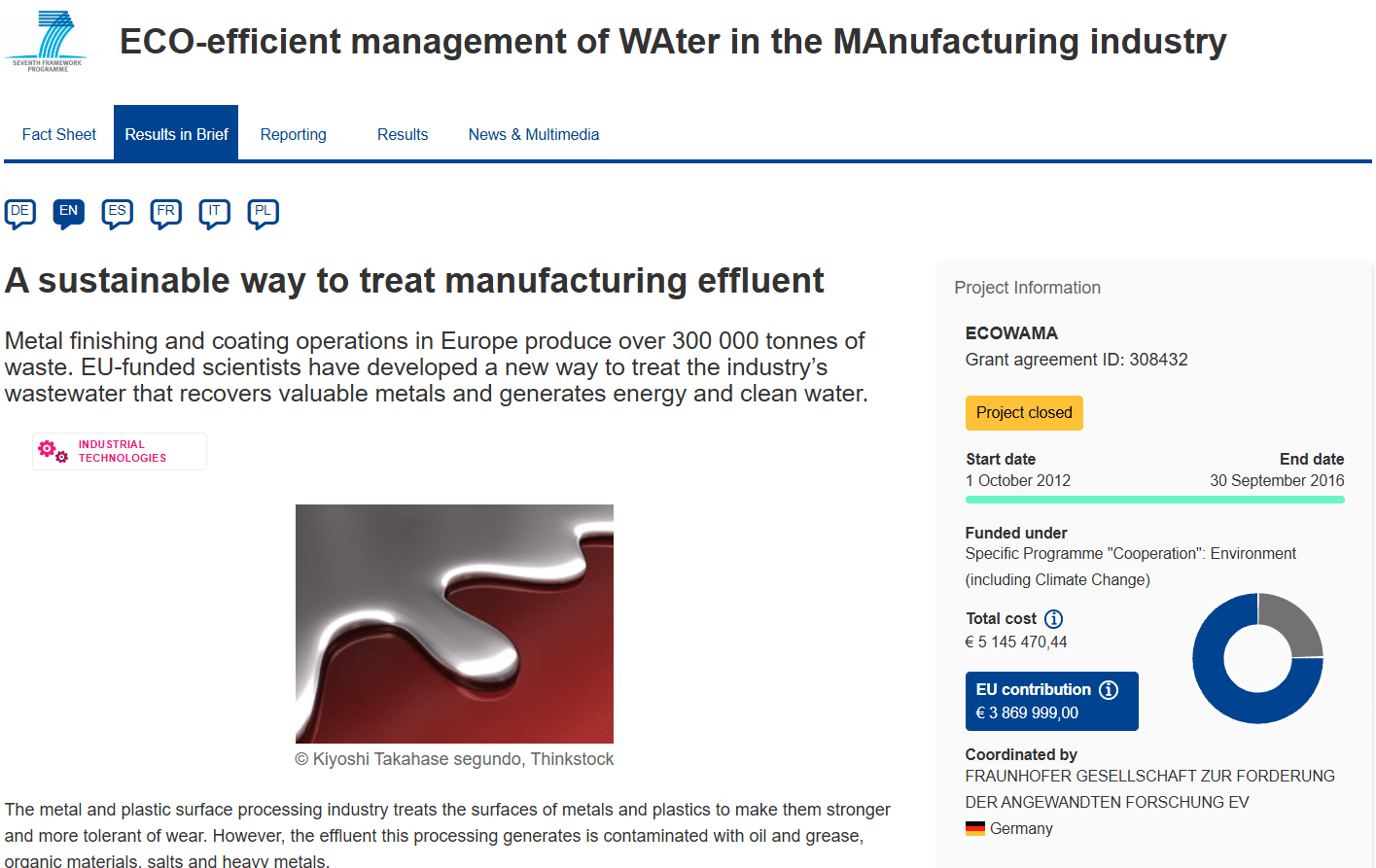
| Grant Agreement ID | 308432 |
| Total Project Budget | €5,161,470 |
| Project Duration | October 2012 – September 2016 |
| Consortium Blueprint | 11 international partners from science and industry |
2. Project Scope: The Clean, Closed-Loop Concept
The core ambition of ECOWAMA was to engineer a chemical-free, modular treatment architecture capable of operating with near-zero emissions. Rather than introducing additional precipitating chemicals that create large volumes of unrecyclable hazardous sludge, the project focused strictly on electrochemical and physical separation mechanisms.
The scope focused on three interconnected recovery pipelines:
- Ultrapure Water Reclamation: Extracting high-conductivity salts and contaminants to yield high-quality water suitable for immediate reintroduction into industrial cleaning and galvanic plating baths.
- High-Purity Metal Extraction: Separating target heavy metal ions from the waste stream and reducing them back into a solid, uncompounded metallic state.
- Secondary Energy Capture: Harvesting the implicit chemical energy byproducts generated during electrolytic processing to help offset the operational electrical demands of the system.
3. Key Deliverables & Process Stages
The primary physical deliverable of the project was a fully automated, semi-industrial scale pilot demonstration plant integrating several advanced electrochemical stages.
Pre-Treatment & Concentration
Before entering the core electrolytic reactors, raw manufacturing effluent undergoes specialized physical filtering to strip away suspended oils, surface lubricants, and bulk grease. To maximize the efficiency of subsequent electrical extraction, the diluted wastewater stream is passed through a Multi-Stage Humidification-Dehumidification (MHD) process. This thermal module concentrates the wastewater, minimizing the total liquid volume while amplifying ion density.
The Electrochemical Core
The concentrated liquid stream is routed through three sequential electrochemical steps:
- Electrocoagulation: Electrical currents destabilize suspended organic compounds and colloids without requiring standard chemical coagulants, pulling out complex complexes into an easily manageable solid layer.
- Electrooxidation: This module achieves complete breakdown of persistent organic pollutants, targeting tough compounds like hypophosphites and converting them into safe, stable forms.
- Advanced Electrowinning: Utilizing specialized, highly efficient electrode configurations, dissolved heavy metals (such as nickel) are selectively plated out of the liquid stream. The metals attach directly to the cathodes as high-purity solid sheets that can be easily sold on open markets or reused directly inside the factory.
Hydrogen Upgrading & Energy Recovery
A key breakthrough of the ECOWAMA design is its gas-management system. The intense electrical reactions within the electrocoagulation and electrooxidation cells naturally generate hydrogen gas as a byproduct. The system captures, purifies, and feeds this hydrogen directly into localized fuel cells, transforming a volatile waste gas into supplementary electricity that powers the surrounding pumps and control systems.
4. Reporting & Operational Benchmarks
The final performance verification of the ECOWAMA system—field-tested at the active operational facility of Saxonia Galvanik GmbH in Halsbrücke near Dresden, Germany—delivered impressive resource efficiency metrics.
High-Yield Resource Recovery
Empirical logging from the pilot plant operations verified the following baseline efficiencies:
- 100% Hypophosphite Destruction: The electrooxidation matrix achieved complete elimination of hypophosphite fractions from complex electroless nickel waste streams.
- Greater than 90% Nickel Reclamation: Dissolved nickel ions were successfully extracted via electrowinning, yielding elemental nickel of exceptional purity.
- Greater than 85% Clean Water Yield: The integration of the MHD separation system continuously generated highly purified water optimized for closed-loop recycling within the plant’s main cleaning lines.
Socio-Economic & Waste Reductions
By shifting away from chemical precipitation, the ECOWAMA model achieved a 70% reduction in hazardous waste disposal costs for the manufacturing plant. This elimination of heavy sludge handling, combined with the market value of recovered high-purity metals and reduced freshwater intake, demonstrated that the system provides an economically self-sustaining pathway for clean, sustainable surface processing across European industrial sectors.