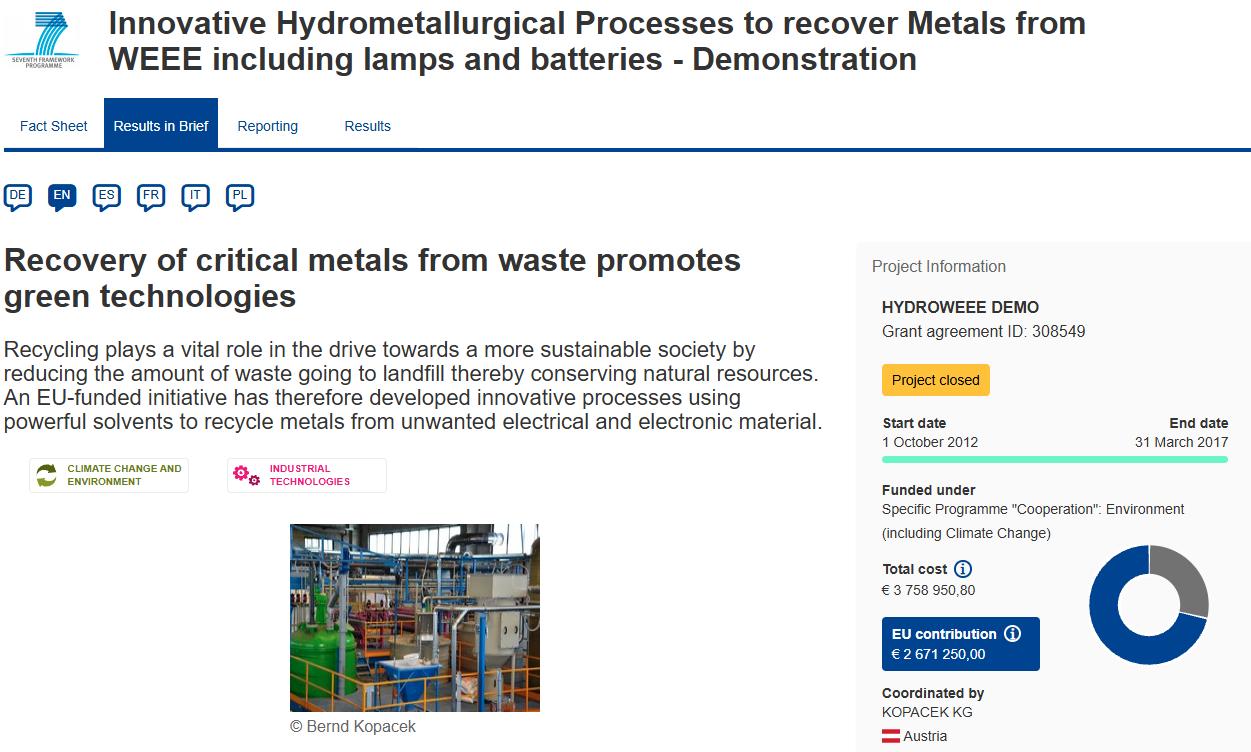
Waste Electrical and Electronic Equipment (WEEE) is the fastest-growing waste stream in Europe, expanding by 3% to 5% every year. Hidden within this mountain of discarded technology lies an abundant supply of precious and critical raw materials. To capture these resources cleanly and cost-effectively, the European Union co-funded the HYDROWEEE DEMO project.
Project Reference: Innovative Hydrometallurgical Processes to recover Metals from WEEE including lamps and batteries – Demonstration (FP7-ENV-308549). For detailed tracking, reference materials, and official data sheets, access theCORDIS Project Pageor the archivedHydroWEEE Web Hub.
The Project Scope
The HYDROWEEE DEMO initiative built directly upon an earlier EU research phase that proved hydrometallurgical processing (extracting metals using liquid solvents) could isolate high-purity rare earth and industrial metals from electronic components. The main objective of the demonstration project was to scale up these laboratory prototypes into two fully functioning, industrial-scale operational plants to validate their commercial and environmental viability.
Rather than traditional pyrometallurgical methods—which rely on high-temperature smelting furnaces that are energy-intensive and produce significant air emissions—the project deployed powerful chemical solvents like sulfuric acid and reducing agents. These liquids selectively leach out critical minerals at lower temperatures, making the recycling loop far more resource-efficient and accessible for small and medium enterprises (SMEs).
The project specifically targeted fractions of e-waste that standard commercial recyclers routinely bypass, treating various input types in unified chemical batches:
| Waste Stream Component | Recovered Metals & Elements | Practical Industrial Reuses |
| Fluorescent Lamps & CRTs | Yttrium (Y), Europium (Eu), Zinc (Zn) | Phosphor powders, electronic displays |
| Spent Li-ion Batteries | Lithium (Li), Cobalt (Co) | Energy storage, electric vehicle mobility |
| Liquid Crystal Displays (LCDs) | Indium (In) | Flat-panel touchscreens, conductive coatings |
| Printed Circuit Boards (PCBs) | Gold (Au), Silver (Ag), Copper (Cu), Nickel (Ni) | Industrial electroplating, new electronics fabrication |
Key Project Deliverables
To bridge the gap between industrial research and market application, the HYDROWEEE DEMO consortium organized its outputs around actionable commercial infrastructure and technical frameworks:
- The Stationary Industrial Plant: A full-scale chemical recycling facility built and integrated permanently into the operational grid of Relight srl in Rho, Italy, designed to continuously process regional e-waste streams.
- The Mobile Containerized Plant: A fully operational, transportable recycling plant built directly into standard shipping containers. This modular setup allows different regional SMEs to share a single chemical reactor sequentially, drastically reducing initial capital expenditure.
- Universal Processing Protocols: Standardized, batch-ready extraction recipes that let plant operators switch between treating spent batteries, crushed LCD glass, or lamp powders without requiring a complete hardware redesign.
- Market Exploitation & Safety Manuals: Complete risk and health assessment documentation, alongside logistical blueprints mapping out how SMEs can sell their processed products straight to end-users (such as electroplating companies), bypassing expensive multi-tier secondary processing firms.
Project Reporting: Key Results & Field Impacts
Final reports compiled across the project’s multi-year operational lifespan yielded substantial breakthroughs for European circular economy goals:
1. High-Purity Yield Optimization
By refining selective precipitation and leaching operations, the plants consistently extracted critical elements like yttrium and indium at purity levels above 95%. For specific target yields like copper and cobalt, the extraction efficiency surpassed 97%, rendering the outputs pure enough to enter secondary manufacturing supply chains directly.
2. Operational Mobility in Action
The mobile containerized unit successfully completed field demonstrations across multiple European test locations, including facilities in Italy, Romania, and Serbia. This proved that complex hydrometallurgical systems could remain stable, safe, and legally compliant under transport conditions, establishing a framework for cross-border infrastructure sharing.
3. Circular Chemistry and Closed Loops
Reporting verified that the hydrometallurgical loop achieved an internal water recycling rate of 85%. By continuously filtering, neutralizing, and reintroducing the process water back into the leaching reactors, the plants significantly lowered both raw water consumption and liquid waste generation.
4. Supply Chain Independence
By proving that high-tech elements like rare earths can be profitably mined from local urban waste, the project created a blueprint for decreasing Europe’s reliance on raw mineral imports. Additionally, lifecycle assessments generated during the reporting cycle confirmed that extracting these metals via urban mining saves considerable carbon emissions compared to traditional primary extraction from rock mines.