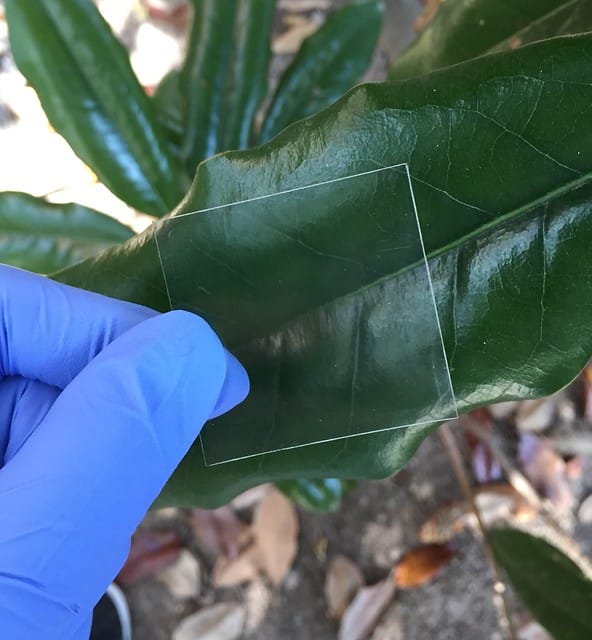
Featured image: Close-up of transparent wood sample held to light, showing clarity and wood grain Citation: “Transparent Wood” by USDA Forest Products Laboratory / University of Maryland researchers, source: “USDA.gov”. (hyperlink the citation to the USDA blog or research page)
Translucent (or transparent) wood is emerging as a revolutionary, eco-friendly alternative to traditional glass and plastic for windows, facades, and even smartphone screens. Developed through processes that remove lignin (the component making wood opaque and brown) and infuse the cellulose structure with a matching polymer, the resulting material is strong, lightweight, thermally insulating, and optically clear or frosted.
Research from the USDA Forest Products Laboratory, University of Maryland, and others shows transparent wood outperforms glass in nearly every metric: it is five times stronger, better at thermal insulation (reducing heating/cooling costs), and more impact-resistant. Produced from fast-growing balsa or other sustainable woods, it has a dramatically lower carbon footprint and is fully renewable.
Companies like Woodoo in France are commercializing augmented timber that is weatherproof, fire-resistant, and up to five times stronger than conventional wood. It can be engineered for electrochromic “smart” properties—tinting on demand with minimal electricity.
Applications include energy-efficient building envelopes, skylights, interior partitions, and even structural glazing. Transparent wood windows allow natural light while providing superior insulation, cutting building energy use significantly. Its hazy, diffused light quality creates warm, inviting interiors unlike harsh glass glare.
Sustainability advantages are compelling: biodegradable or recyclable options, reduced sand mining (glass requires vast silica), and compatibility with existing manufacturing. Recent advances use entirely natural polymers for even greener variants.
Challenges remain around large-scale production consistency and UV stability (addressed with coatings), but costs are competitive and falling. Prototypes already demonstrate viability for residential and commercial use.
The future holds hybrid materials combining transparent wood with solar coatings or sensors. It positions wood—humanity’s oldest building material—as a high-tech solution for the 21st century.
Geam din lemn translucid embodies circular, biomimetic design: turning abundant renewable resources into advanced, beautiful building components. For architects seeking net-zero buildings and homeowners wanting healthier, lower-energy homes, translucent wood windows offer an elegant, sustainable revolution. (Word count: 503)