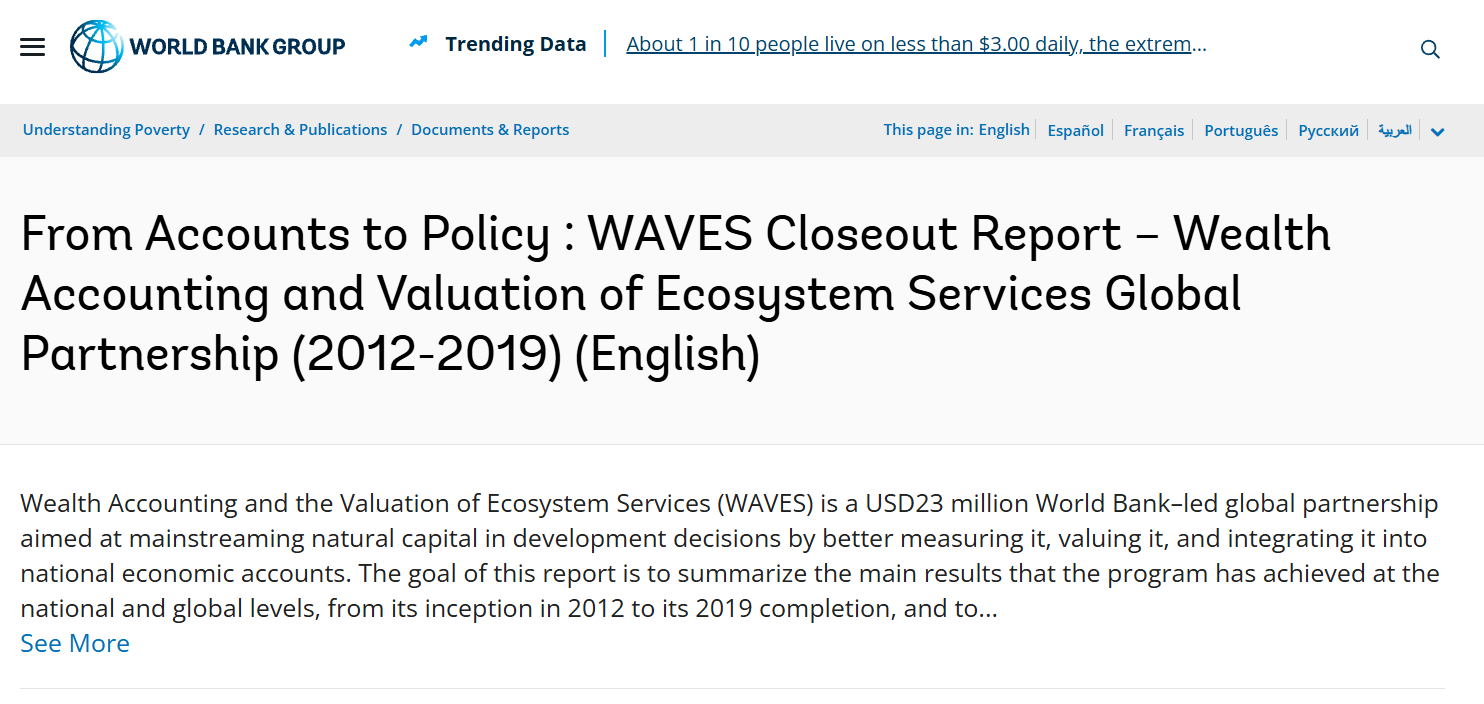
WAVES (Wealth Accounting and the Valuation of Ecosystem Services) is an initiative of the World Bank. WAVES is a global partnership focused on sustainable development that brings together UN agencies, governmental bodies, international institutions, and NGOs, aiming to highlight the importance of natural capital in national economies. WAVES is a project in partnership with UNDP and UNEP, promoted and supported with data from TEEB, based on the SEEA accounting system (described next), through which an attempt is made to evaluate natural capital and ecosystem services in at least 10 pilot countries worldwide (5 developed, 5 developing), in three areas: natural resources and agriculture, minerals and energy, and water and fisheries. Of these, the most advanced in terms of having an account is the Philippines (through the Phil-WAVES project). Waves measures three forms of capital and goods generated by a state as “accounting” components of well-being: 1. manufactured capital, such as buildings and public infrastructure; 2. human, social, and institutional capital, such as a country’s education level, rule of law, and governance; and 3. natural capital, such as land, forests, fish, minerals, and energy.
Through WAVES, it is proposed to complete the measurement of a country’s wealth by incorporating the term natural capital, alongside the classical notion of financial income, including services (not just private goods), because this way, the sustainability of the state’s development can be predicted more realistically and over a longer term. This is interesting because by introducing resource consumption as an economic indicator, it can reveal how future generations will no longer benefit from the same quantity of respective resources, and thus there is the possibility that they will be poorer. The challenge is thus clearer: how to grow a country’s wealth without consuming natural reserves.
One of the aspects motivating the WAVES initiative is the fact that a portion of the services provided by nature are not all (or well) represented in the GDP. An example is forests, which are included in the GDP through products derived from the wood industry, but not the service of carbon sequestration (and thus unmeasurable, including the medium-term impact of CO2 trapping) or the action and impact of air filtering, with indirect impact on the health of the entire trophic chain, including local human beneficiary communities.
From an institutional point of view, WAVES involves central banks and national ministries of economy or development, for more realistic planning of investments, and changes in the use of land and existing ecosystems.
Additionally, implementing a natural capital accounting system based on the SEEA system in the pilot countries, the partnership also aims to integrate this type of economy into policy analyses and planning, and to develop guidelines for standardizing ecosystem services and adopting natural capital economics on a global scale.