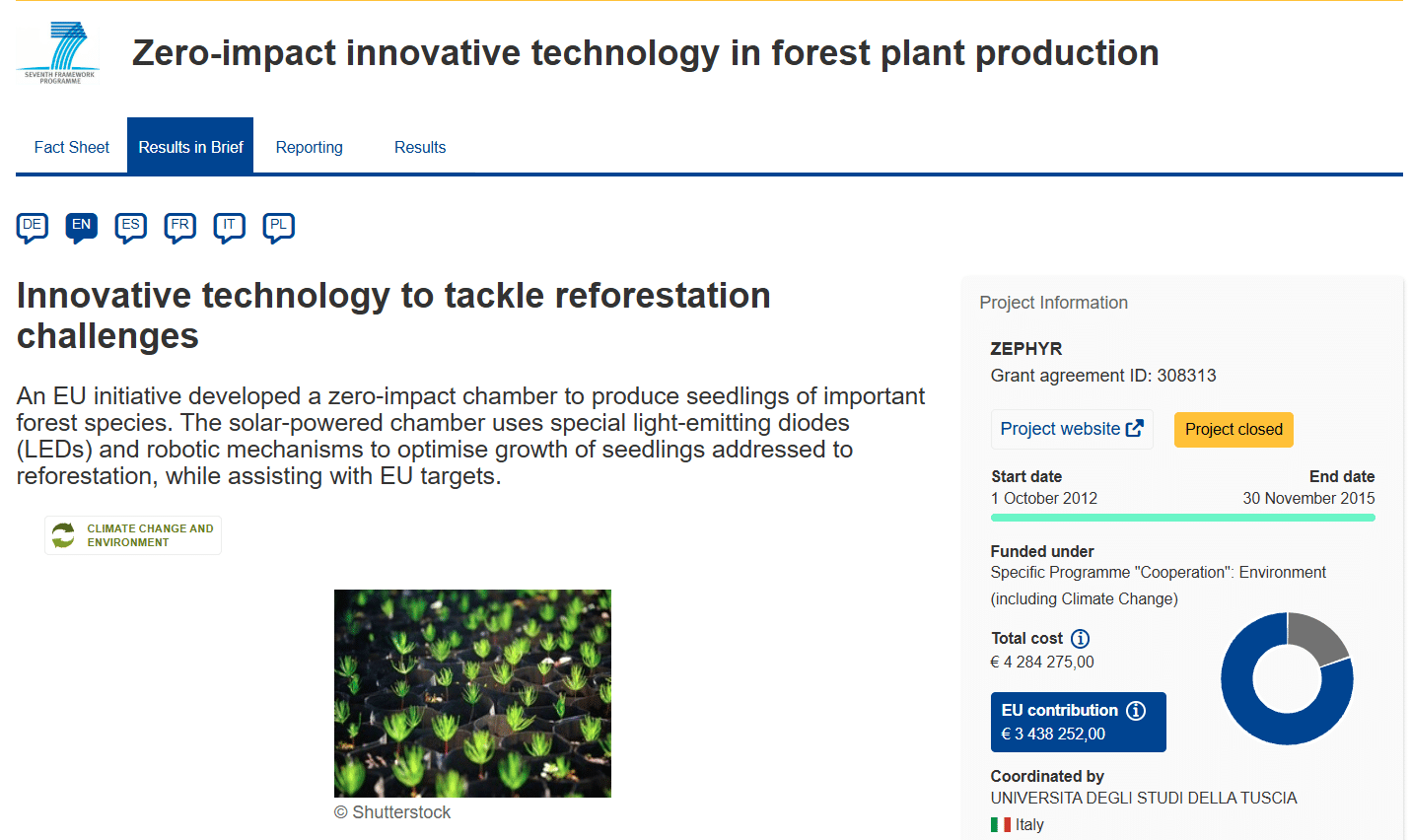
Featured Image: Project ZEPHYR: Innovative Technology to Tackle Reforestation Challenges
Project Name: ZEPHYR (Zero-impact innovative technology in forest plant production)
Source: EU CORDIS Project Website
As climate change accelerates, natural forests increasingly struggle to regenerate on their own. Assisted reforestation is a vital tool for environmental recovery, yet traditional open-air and greenhouse nurseries are highly vulnerable to extreme weather, require significant land mass, and consume substantial water and chemical inputs.
To solve these compounding bottlenecks, the EU-funded ZEPHYR initiative pioneered a mobile, fully automated, zero-impact cultivation unit designed to produce highly resilient, standardized forest seedlings completely isolated from harsh outdoor conditions.
Project Scope: A Controlled Environment in a Shipping Container
Funded under the European Union’s Seventh Framework Programme (FP7), the ZEPHYR project gathered an international consortium of tech companies and forestry research institutes. Their objective was to design a self-contained, high-density cultivation chamber housed entirely within a standard TEU shipping container.
The primary scope aimed to optimize the early pre-cultivation phase—the most critical stage where seeds develop the robust root systems required to survive ultimate field transplantation. Crucially, the system focuses on growing seedlings directly from high-diversity wild seeds rather than identical clones, ensuring the genetic biodiversity of restored forests is fully preserved.
Key Deliverables and Architectural Hardware
The project successfully engineered and field-tested a functional prototype containing three core technical innovations:
- Revolving Tray Assembly: The unit houses 10 motorized shelves carrying 20 plant trays in a continuous vertical rotation. In conventional static greenhouses, seedlings near heaters or lamps get uneven microclimates. ZEPHYR’s rotating mechanism guarantees every single seedling experiences the exact same average light intensity, temperature, and humidity.
- Precision LED Spectra: Instead of utilizing traditional hot overhead fixtures, the system deploys custom-engineered energy-efficient LED arrays. These lamps provide a customized light spectrum optimized purely for tree photosynthesis without creating unnecessary waste heat.
- Robotic Assistant & Wireless Diagnostics: A robotic arm equipped with stereoscopic optical cameras scans the individual “mini-plugs” (very small substrate containers under 37 cubic centimeters in volume). Paired with wireless soil microsensors, the system tracks shoot growth, root progress, and moisture levels remotely in real time.
- Foldable Solar Array: To truly claim a “zero-impact” footprint, the container features a foldable array of 20 photovoltaic panels mounted on the roof, allowing the entire nursery to operate completely off-grid.
Reporting: Operational Performance Benchmarks
Final reporting and field validation demonstrated that the automated indoor micro-climate drastically outpaced standard agricultural greenhouse operations. Because the system runs completely independent of seasonal weather variations, it slashes nursery cycle durations to just 30 days.
Operational Data: By compressing growth timelines, the unit can execute up to 11 complete cultivation cycles per year, effectively delivering “just-in-time” seedling stock to forest managers exactly when seasonal planting windows open.
Comparative Efficiency Gains (ZEPHYR vs. Standard Greenhouse)
| Performance Dimension | Reported Technical Improvement |
| Surface Area Footprint | 495% space saving (due to vertical stacking and rapid multi-cycle annual turnover) |
| Energy Consumption | 85% reduction in power demand (via optimized LEDs and low-load continuous rotation) |
| Water Efficiency | Near 100% Water Application Efficiency (WAE) (zero evaporation due to a closed bottom-tank immersion system) |
| Chemical Elimination | 100% elimination of pesticides and herbicides during the indoor growth cycle |
| Production Speed | 74% reduction in overall pre-cultivation time requirements |