Introduction
As global supply chains grow increasingly complex, understanding the exact environmental footprint of consumer goods has become a persistent challenge. Traditional corporate sustainability reporting offers retrospective, macro-level snapshots that rarely translate to the grocery aisle or checkout counter.
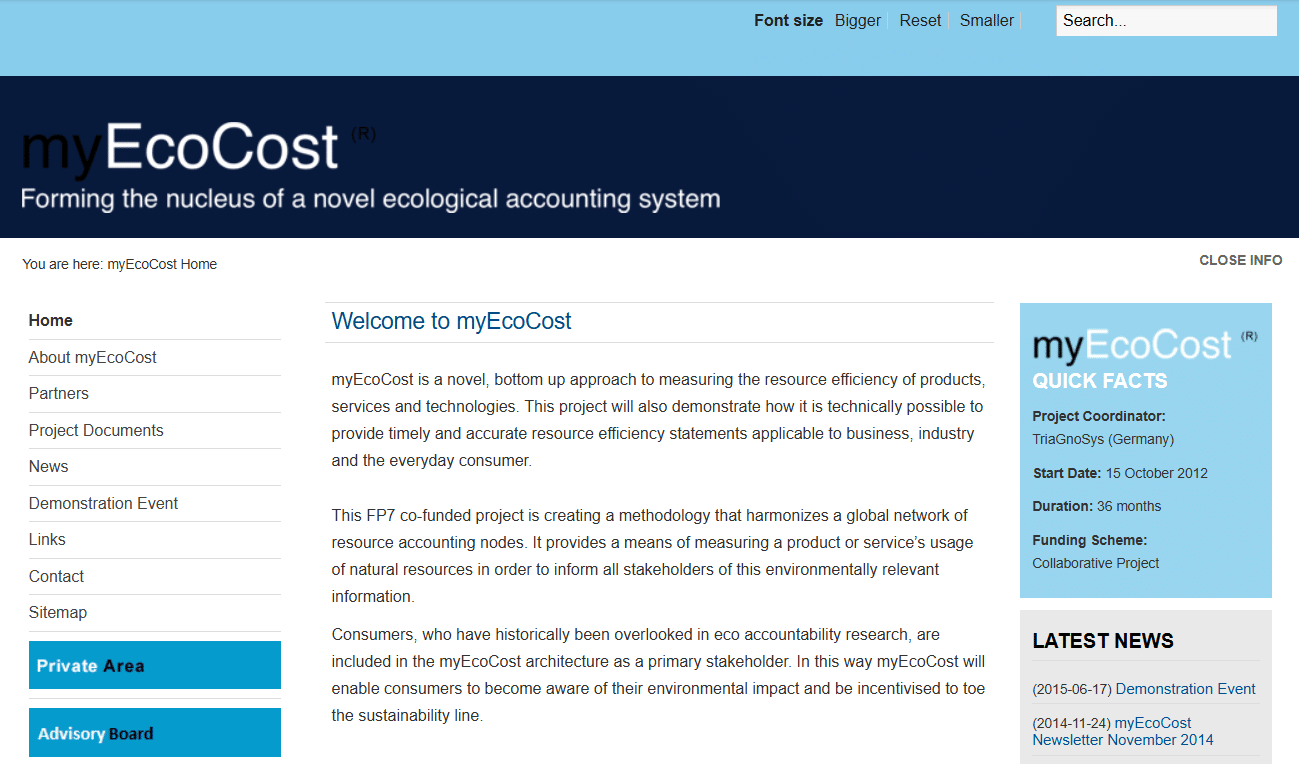
To bridge this gap, the EU-funded myEcoCost project, supported by the European Commission’s Seventh Framework Programme (FP7) under the Eco-environment stream, was established to build a localized, transparent alternative (Huang et al., 2020). Designed as a consumer-oriented prototype, myEcoCost forms the structural nucleus of a distributed Ecological Accounting System—a paradigm shift that treats ecological impacts with the same real-time precision as financial accounting.
Project Scope: Decentralized Ecological Tracking
The fundamental scope of myEcoCost was to design and build an automated Information and Communication Technology (ICT) infrastructure capable of calculating the environmental footprint of products and services moving along value chains, passing this data natively to the final consumer (Peng et al., 2021).
Rather than relying on vague “green” labels, the project aimed to instantiate a bottom-up data tracking model.
“The ultimate objective of an Ecological Accounting System is to transform abstract lifecycle data into an actionable environmental currency, allowing users to track their personal footprint with the same immediacy as a digital bank account.”
Key Methodological Pillars
- Life Cycle Assessment (LCA) Integration: The framework connects directly into production phases—from raw material extraction to transport and manufacturing—to compile rigorous input and output flows (Wang & Su, 2022).
- Focused Environmental Metrics: While modern environmental models incorporate a massive spectrum of indicators, the core myEcoCost system specifically established data pathways focused on two foundational metrics: carbon footprints and material footprints (Huang et al., 2020; Wang & Su, 2022).
Core Infrastructure & Key Deliverables
The project successfully moved from theoretical architecture to a functional software environment. By connecting decentralized server nodes across production stages, myEcoCost proved that ecological overhead can be logged step-by-step and converted into an aggregated “eco-cost” score (Peng et al., 2021).
The architectural ecosystem is broken down into four foundational modules:
| Module / Deliverable | Technical Functionality | Primary Target Group |
| Eco-Cost Calculation Engine | Dynamically assesses life-cycle inventories (LCI) to compute a product’s negative ecological footprint across the value chain (Huang et al., 2020). | Manufacturers, Suppliers, & Logistics Providers |
| Consumer Eco-Account | A personal, bank-style digital wallet that continuously registers accumulated environmental debits and balances (Huang et al., 2020). | Individual End-Consumers |
| Eco-Shopping Mobile App | A user-facing prototype application allowing consumers to scan barcodes, review real-time eco-costs, and compare alternatives before buying. | Shoppers & Retail Partners |
| Eco-Incentive & Credit System | A module tracking “eco-credits” awarded to users when they responsibly return or recycle products at the end of their lifecycle (Huang et al., 2020). | Recyclers & Circular Economy Stakeholders |
Technical Architecture Highlights
- The Data Pipeline: To ensure calculations did not bog down retail environments, the project explored high-performance web systems and automated parsing tools (such as converting complex XML-based EcoSpold LCA databases into scalable SQL architectures) to handle massive transaction computing loads seamlessly (Peng et al., 2021).
- The Feedback Loop: When an item is bought, its negative environmental impact (Eco-Cost) is logged in the user’s app (Huang et al., 2020). Conversely, when an item is properly recycled, the consumer earns positive Eco-Credits, which can be redeemed for localized promotions, discounts, or community incentives (Huang et al., 2020).
Project Reporting & Circular Legacy
Pilot testing and simulated case studies yielded highly encouraging results regarding data tracking integrity and behavioral changes:
- Value Chain Integrity: Incorporating tracking hardware like barcodes and RFID tags demonstrated that environmental data can scale effectively alongside inventory management, moving fluidly between businesses without breaking the information chain (Peng et al., 2021).
- Empowered Consumer Choices: Providing a clear, localized metric parallel to financial pricing tags minimized the friction behind eco-conscious shopping, allowing immediate evaluation of sustainable products right at the point of sale (Wang & Su, 2022).
- The Nucleus of Modern Digital Passports: The computational methods and mobile infrastructure optimized during the myEcoCost project laid the immediate technical foundations for successor European initiatives, such as the Horizon 2020 CIRC4Life project, which scaled the system into a comprehensive 17-indicator ReCiPe LCA framework (Huang et al., 2020; Wang & Su, 2022).
By demonstrating that environmental accountability can be integrated into consumer-facing mobile platforms, myEcoCost successfully pioneered the core mechanisms now widely regarded as essential for digital product passports and transparent circular economies.
References
Huang, H., Su, D., Peng, W., & Wu, Y. (2020). Development of a Mobile Application System for Eco-Accounting. Sustainability, 12(22), 9675. https://doi.org/10.3390/su12229675
Cited by: 12
Peng, W., Su, D., & Wang, S. (2021). Development of an Innovative ICT Infrastructure for an Eco-Cost System with Life Cycle Assessment. Sustainability, 13(6), 3118. https://doi.org/10.3390/su13063118
Cited by: 9
Wang, S., & Su, D. (2022). Sustainable Product Innovation and Consumer Communication. Sustainability, 14(14), 8395. https://doi.org/10.3390/su14148395
Cited by: 47