Project Name: Advanced Model Development and Validation for Improved Analysis of Costs and Impacts of Mitigation Policies (ADVANCE) | Source: EU CORDIS Project Portal
When global leaders committed to keeping global warming well below 2°C under the Paris Agreement, they relied heavily on mathematical blueprints called Integrated Assessment Models (IAMs). These complex models simulate how human economics, energy systems, and land use interact with the Earth’s climate.
However, early generations of IAMs had massive blind spots, particularly regarding how consumer behavior, specific industries, and localized energy policies actually work in reality. To fix this, the European Union funded the ADVANCE project under the Seventh Framework Programme (FP7).
Coordinated by leading institutions like the Potsdam Institute for Climate Impact Research (PIK), ADVANCE spent four years overhauling, validating, and harmonizing the world’s most prominent climate models to deliver highly precise, actionable policy insights.
Project Scope: Overhauling the Engines of Policy Design
The primary mission of ADVANCE was to significantly improve the representation of energy-economic-environmental systems within global and regional IAMs. Instead of treating energy demand as an abstract variable, the project looked deeply into individual end-use sectors to understand the true costs and bottlenecks of decarbonization.
The scientific scope was carved into several core technical domains:
- The Demand-Side Revolution: Breaking down macro-energy consumption into specific, high-emissions sub-sectors—namely passenger and freight transport, heavy industry, and residential buildings.
- Policy and Subsidies Integration: Moving beyond idealized carbon-pricing scenarios to model the real-world friction of existing energy taxes, fossil fuel subsidies, and renewable incentives.
- Model Diagnostics and Transparency: Creating a unified framework to test why different models produce vastly different results when given the exact same climate target.
Key Deliverables and Innovations
The ADVANCE consortium successfully upgraded major global models (such as REMIND, WITCH, AIM-CGE, POLES, and IMAGE), leaving behind a suite of open-source datasets, diagnostic toolkits, and sector-specific model updates.
- Unified Energy Policy Database: A comprehensive dataset tracking global energy taxes and subsidies, allowing IAMs to accurately simulate the economic impact of phasing out fossil fuel support.
- Advanced Technology Diffusion & Learning Curves: Empirically grounded mathematical models that project how fast technologies like wind, solar PV, and electric vehicles drop in price as cumulative global capacity expands.
- Upgraded Sectoral Modules:
- Transport: Explicitly integrated road freight intensity and modal split variations (e.g., shifting from long-haul trucks to rail) relative to GDP growth.
- Industry: Highly detailed structural breakdowns of energy-intensive manufacturing processes (steel, cement, chemicals) rather than general economic aggregations.
- The IAM Diagnostic Toolset: A standardized set of six key performance indicators that allows researchers worldwide to run “diagnostic checks” on their models, drastically increasing scientific transparency and reproducibility.
Project Reporting & Key Analytical Insights
The reporting and synthesis outputs generated by ADVANCE provided a clearer, more realistic map of what deep decarbonization demands.
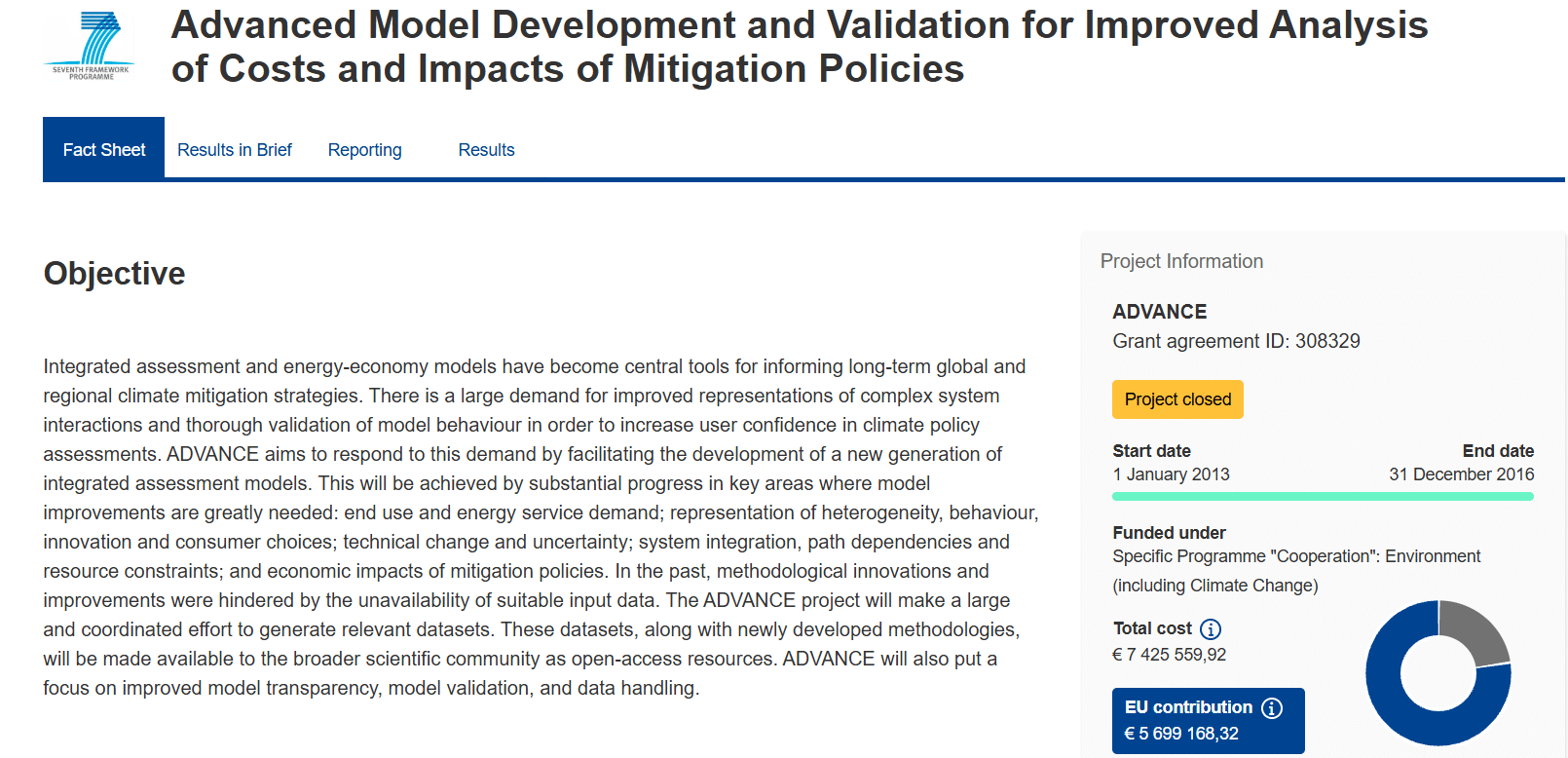
Project Metadata Overview
| Metric / Attribute | Value / Description |
| Project ID | 308329 |
| Funding Scheme | FP7-COOPERATION-ENV |
| Total EU Contribution | €5,699,168.32 |
| Project Duration | January 2013 – December 2016 |
| Key Participating Bodies | PIK (Germany), IIASA (Austria), FEEM (Italy), JRC (European Commission) |
Core Insights from Final Reporting
On the Reality of the 1.5°C Limit:
“Achieving stabilization below 1.5°C or 2°C cannot rely solely on the energy supply sector. It places an immense, immediate burden on demand-side transformation. Without rapid electrification, aggressive energy efficiency gains, and structural lifestyle changes, supply-side solutions alone will suffer from severe economic and physical bottlenecks.”
- The Cost of Subsidy Distortions: Work Package 3 demonstrated that failure to model existing subsidies leads to a major underestimation of the actual policy effort required to initiate a clean energy transition. Conversely, redirecting fossil fuel subsidy revenues into broader tax relief can yield substantial macroeconomic welfare benefits.
- The Long-Haul Freight Hurdle: While passenger transport models show a clear, highly viable path toward electrification, ADVANCE modeling revealed that heavy road freight and aviation remain the most stubborn anchors of carbon lock-in, requiring a much higher reliance on alternative fuel infrastructure or systemic demand reduction than previously thought.
- Employment and Structural Shifting: Integrated assessment reporting underscored that a well-below 2°C transition fundamentally reallocates labor, boosting global energy sector employment from roughly 18 million to over 26 million by 2050, primarily driven by construction and manufacturing in the renewable sectors.