
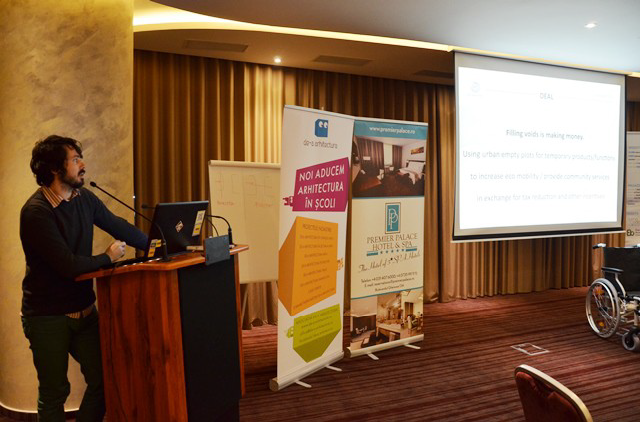
In 2016, Climathon (October 28th) took place in both Timisoara and Bucharest, Romania. The latter was organized by the group Better with the theme “Ecomobility in a Smart, Green City,” where I presented the proposal (in English) “Filling Voids is Making Money.” This proposal was a synthesis of materials, comments, and debates from a broader team of architects and citizens involved in the workshop’s theme, including architects Florin Enache, Bianca Constantin, and Simona Calapodescu, among others. Other solutions were illustrated by ad hoc teams of engineers, cyclists, UAUIM mobility master’s students, and architects Horia Bejan and the organizers. The jury included specialists, local authority representatives, and politicians.
The online environmental news platform Green Report published an article about the event (reporter Irina Breniuc): “Adrian Ibric and his team of architects proposed using temporarily abandoned land in cities. One idea would be to create sustainable parking areas with photovoltaic or green roofs to temporarily solve the parking problem in cities. Another would be to green or decorate fences at the edge of abandoned properties, fences whose appearance discourages citizens from passing by them.”
The core idea behind the “Filling Voids is Making Money” presentation was that local authorities, neighborhood communities, and landowners of vacant lots that lack maintenance options should form action groups based on the “win-win” principle. With minimal interventions, these vacant or abandoned urban lots, including their boundaries, could be used as temporary interfaces, products, and functions to increase ecological mobility and offer community services, in exchange for reduced taxes and other incentives for private landowners.
This paradigm, focused on minimal intervention to make use of repurposed space, is based on the broken windows theory. This theory suggests that a clean, orderly, and socially positive urban environment discourages anti-social behavior.
The proposal was structured in the classic Climathon format:
- DEAL – Business, Understanding: Utilizing abandoned spaces for community purposes.
- CLIENTS – Potential Clients: Public/private owners of vacant urban parcels, local administrations, business angels (for new services), and entrepreneurs/ecopreneurs.
- MARKET – Market and Potential Business Types: Parking services, advertising agencies, marketing departments, and local administrations.
- PRODUCT – Offered Products: Transforming vacant spaces into architectural interfaces / Providing eco-mobility services on LOT (Ecological parking with photovoltaic/green roofs) and LIMIT (Interactive, creative, media, or green fences, even urban agricultural) and new URBAN POLICIES for (re)defining the regulation of unused interstitial space and urban boundaries (collages with examples are included on the following pages).
- FINANCIALS – Financial Aspects: Potential for higher income for the Local Administration through the taxation of new services, the possibility of selling adjacent properties (yards, houses, and apartments) at a higher price due to increased neighborhood image and comfort, and again, higher income for the administration. On the other hand, lower local taxes for owners of vacant parcels make these spaces available and, where possible, rent them to potential mobile, seasonal, or temporary businesses.
- CLIMATE IMPACT – Environmental Impact: Reducing unauthorized parking and freeing up sidewalks and alleys or side lanes, which leads to faster, less polluting auto (lighter and faster traffic), bicycle, and pedestrian mobility (green energy, more green spaces), and environmental education for the community, especially for new generations, through an example of good practice.
- COMPETITIVE ADVANTAGE, NEEDS, ISSUES – Competitive Advantage: Transforming problems such as unkempt, abandoned, neglected, unused, unproductive, unsightly spaces, and potentially problem-generating urban areas (foci of infection, dirt, garbage) into opportunities – modernized spaces, vibrant, inexpensive-to-rent interfaces (for entrepreneurs), street promotion for neighborhoods and administrations, energy production, green areas, recreation spaces, or urban gardening – particularly useful in areas without parks, so residents don’t have to travel by car to reach them. It was also proposed to use some voids for temporary neighborhood parking (as already exists, especially in the city center), although this proposal provoked a lively debate among the audience and jury members, given that it could lead to increased traffic and continued congestion, despite the advantage that parking would be equipped with solar, photovoltaic, or green roofs.
- TEAM & FOUNDER’S DREAM – Team Vision: “Improving our cities by converting ugly voids into better, greener, more communicative urban areas.”
- MOBILITY / INDIVIDUAL PROBLEMS – Mobility and Individual Problems: The possibility of legal parking without occupying sidewalks, reducing pollution and unproductive traffic generated by waiting and the stress, time, and money spent in a car, and increased contact with green space.
- SOCIAL & CULTURAL ADVANTAGES – Social and Cultural Advantages: Passion for urban regeneration, new splashes of color, new businesses, involved locals, neighborhood events, a more united community, and a change from traditional somber clichés – 3-meter-high rusted fences for abandoned construction sites or unkempt bushes where dogs or street people gather.
- BUSINESS PLAN – Business Plan: A viable business plan for this idea was a mobile and internet APPLICATION, with mapping of the relevant land – a complete map of the city of Bucharest (but the concept can be applied globally), following the model of Calup (which subsequently led to the creation of NOD Makerspace) or the Yplan Geoblog Android application for public spaces. The online solution could connect owners with citizens, communities, tenants’ associations, or entrepreneurs, all of whom would be part of an administrative program to benefit from potential subsidies/reductions/deductions/incentives, etc. There’s a foreign website dedicated to abandoned sites for photographers seeking such backgrounds or settings for their sessions – SHOT HOTSPOT.

