Featured image: Composite or collage-style image showing Newspaper Wood furniture/ veneer next to E-board panels and Decafe coffee-waste tiles (warm, textured, recycled aesthetic). Citation: “Newspaper Wood, E-board & Decafe Tiles” by Mieke Meijer / Enviro Board / Waste Matters Studio, source: “MaterialDistrict or NewspaperWood.com”.
In the shift toward circular design, Newspaper Wood, E-board by Enviro, and Decafe Tiles exemplify how everyday waste can become premium, sustainable materials for interiors, furniture, and architecture. These innovations divert waste from landfills, reduce virgin resource consumption, and deliver unique aesthetics with strong environmental credentials.
Newspaper Wood, developed by Dutch designer Mieke Meijer, reverses the traditional paper-making process. Layers of recycled newspapers are glued, compressed into logs or sheets, and cut to reveal a wood-like grain where printed text creates distinctive patterns. The material is lightweight, workable with standard tools, and fully recyclable in existing paper streams. It is used for furniture, veneers, flooring, and decorative panels, offering a storytelling element—each piece carries fragments of history while avoiding new tree harvesting.
E-board from Enviro Board Corporation transforms agricultural waste—rice straw, wheat straw, sugarcane bagasse, and similar fibers—into strong, stable building boards through a patented milling and pressing process. These panels serve as sustainable alternatives to plywood, particleboard, or OSB in walls, ceilings, and furniture. They are formaldehyde-free, fire-resistant in treated forms, and exhibit excellent dimensional stability and insulation properties. By valorizing crop residues that are often burned (contributing to air pollution), E-board supports rural economies and sequesters carbon in durable products.
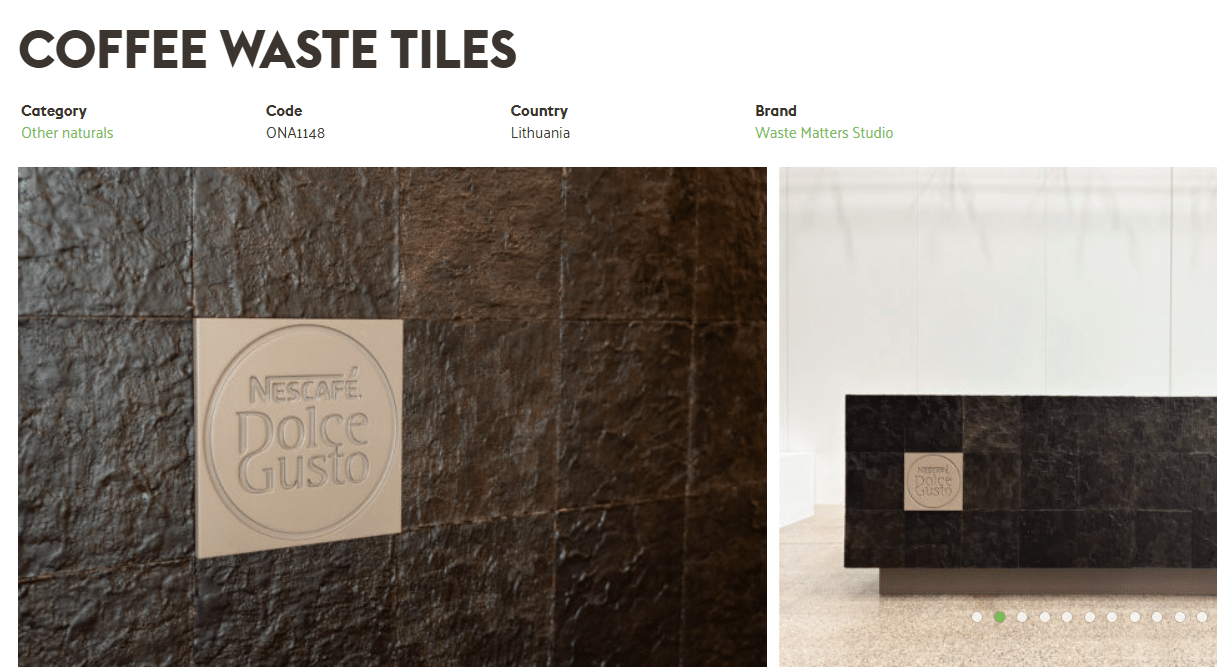
Decafe Tiles (and similar coffee-waste materials) repurpose spent coffee grounds—millions of tons generated globally each year—by mixing them with natural bio-resins or binders. The result is warm, tactile tiles with rich brown tones and subtle aroma remnants in some formulations. Handcrafted or molded, they are used for wall cladding, flooring accents, and furniture surfaces. Low-emission, biodegradable options reduce landfill waste and CO₂ while offering a sensory connection to their origin.
Together, these materials create cohesive eco-interiors: Newspaper Wood for organic, narrative-driven elements; E-board for structural and large-scale applications; and Decafe Tiles for accent textures and color. All prioritize recycled or waste feedstocks, minimizing embodied carbon and toxicity. They are workable with conventional tools, aesthetically versatile, and align with green building standards such as LEED or Living Building Challenge.
Benefits extend beyond the environment. Clients gain distinctive designs that tell sustainability stories, potentially commanding premium pricing. Builders benefit from lightweight, easy-to-install materials that reduce transport emissions and structural loads.
Challenges include moisture sensitivity (addressed with sealants) and consistent supply/quality at scale, but growing demand and technological refinements are resolving these. Future potential includes hybrid composites—Newspaper Wood with coffee or straw fibers—and smart integrations with conductive inks.
Newspaper Wood, E-board, and Decafe Tiles demonstrate that waste is merely a resource out of place. By transforming newspapers, straw, and coffee grounds into beautiful, functional design materials, they advance a circular economy where creativity and sustainability go hand in hand. For designers and builders committed to regenerative practices, these solutions offer practical elegance and genuine environmental impact. (Word count: 502)