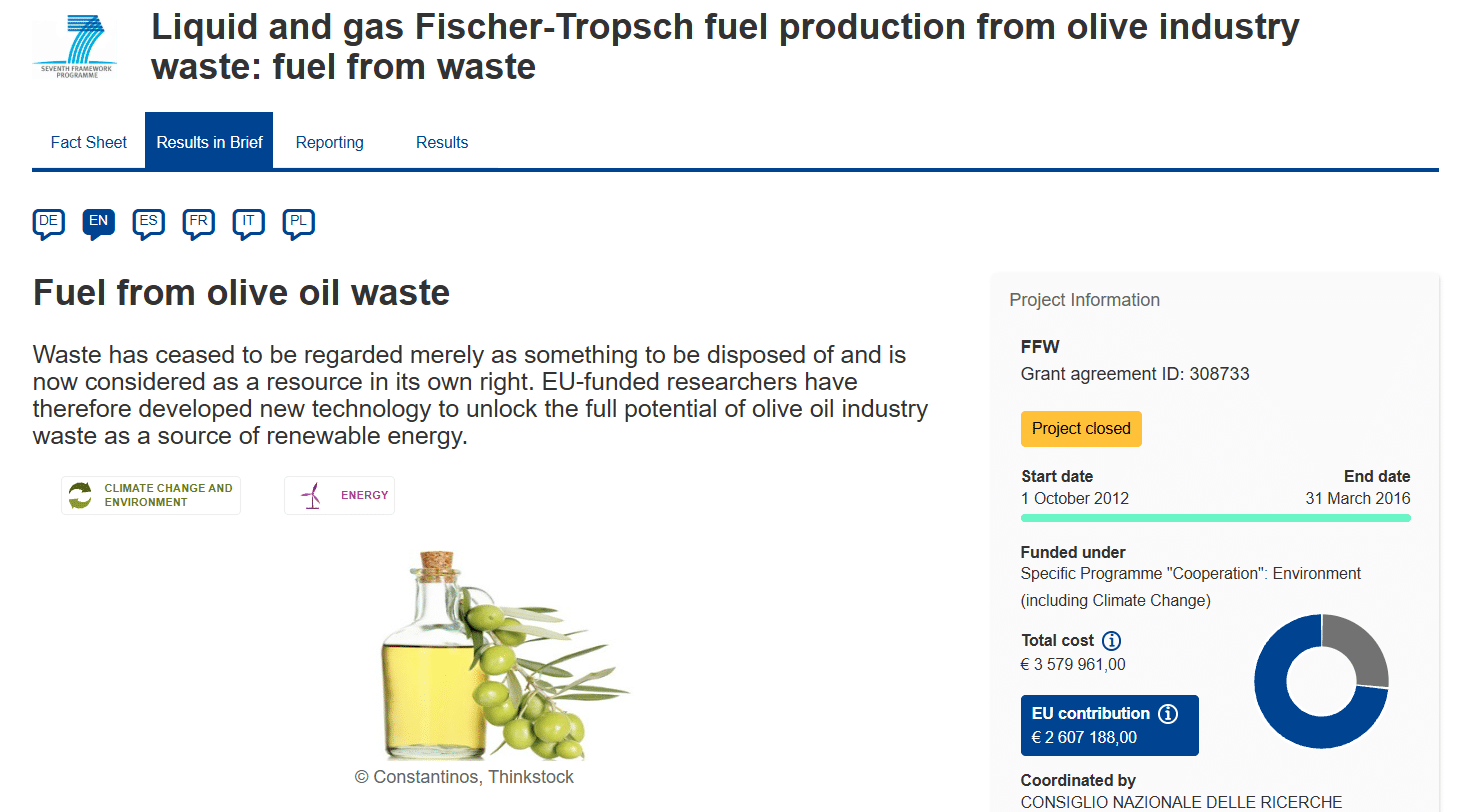
Featured Image: Project FFW: Sustainable Biofuel Production from Olive Residues
Project Name: FFW (Liquid and gas Fischer-Tropsch fuel production from olive industry waste: fuel from waste)
Source: EU CORDIS Project Website
As the global push for renewable energy intensifies, treating agricultural by-products as valuable resources rather than disposal headaches has become the cornerstone of the circular economy. A standout initiative funded under the European Union’s Seventh Framework Programme (FP7)—the FFW project—took on the challenge of greening one of the Mediterranean’s most iconic, yet waste-heavy sectors: the olive oil industry.
By convening experts from eight European countries, the FFW project sought to establish a technically viable and highly profitable method to convert olive industry residues into high-quality, synthetic fuels.
Project Scope: Powering the Mediterranean Olive Sector
The Mediterranean basin produces a massive share of the world’s olive oil, but the extraction process generates staggering volumes of problematic by-products. The scope of the FFW project centered on gathering, characterizing, and utilizing these specific waste materials:
- Olive pits
- Olive pomace (the dense mixture of skins, pulp, and stones)
- Remains from seasonal olive tree pruning
Conventionally, these residues pose tough disposal challenges due to their high moisture levels, acidity, and phytotoxic organic compounds. FFW aimed to decentralize fuel production by creating localized systems where this abundant biomass could be pre-treated, gasified, and chemically synthesized into clean energy on-site.
Key Deliverables and Technical Innovations
The FFW initiative successfully pushed past the traditional limitations of biomass conversion by focusing on advanced thermochemical processing. The primary deliverables of the project included:
- Feedstock Assessment and Surveys: Quantifying available agricultural remains across partner regions and establishing localized logistics models.
- Syngas Optimization via Gasification: Developing efficient thermochemical gasification methods to turn solid olive residues into high-quality synthesis gas (syngas).
- Advanced Membrane Purification: Introducing innovative membrane separation techniques to clean the syngas, ensuring it was free of contaminants that could ruin downstream equipment.
- Novel Fischer-Tropsch Catalysts: Formulating next-generation catalysts tailored specifically to boost the chemical conversion efficiency of olive-derived syngas into liquid hydrocarbons.
- Dual Fuel Production Channels: * Synthetic Natural Gas (SNG): Formulated to provide clean, reliable heat directly back to the olive mills.
- Liquid Biodiesel: Tailored to match fossil-derived diesel specifications, allowing it to power the heavy trucks and tractors used in olive farming.
Reporting: Feasibility and Sector Impacts
Project reporting highlighted that scaling up this thermochemical pipeline is entirely feasible at commercial levels. Researchers evaluated not only the technical thresholds of the Fischer-Tropsch synthesis but also how local communities and businesses perceived the change.
Project Finding: Shifting from landfill disposal to localized thermochemical biorefining yields a clear, reliable baseline for reducing both an industrial mill’s operating costs and its overall environmental footprint.
Summary of Project Sustainability Benefits
| Dimension | Impact and Achievement |
| Environmental Footprint | Diverts toxic pomace from landfills, protecting local water tables while achieving near net-zero greenhouse gas emissions. |
| Economic Independence | Protects rural economies from volatile fossil fuel markets by replacing imported diesel with self-generated agricultural fuel. |
| Agricultural Efficiency | Integrates an otherwise wasteful process into a closed-loop system, upgrading traditional mills into localized biorefineries. |
Ultimately, the deliverables generated by the FFW project established a framework for future upgrades in the agricultural sector, proving that tomorrow’s fuel might just come from yesterday’s harvest waste.
You can see a real-world application of these concepts in action through this coverage of a Tunisian Company Converting Olive Waste into Fuel, which highlights how regional businesses are successfully commercializing olive residues as an eco-friendly energy source.