Biodiversity across terrestrial, marine, and freshwater ecosystems has faced unprecedented pressure over recent decades. While vast amounts of environmental and biological data are collected across Europe, this monitoring infrastructure has historically been fragmented. Datasets often suffer from taxonomic biases, inconsistent data collection methods, and significant geographic gaps.
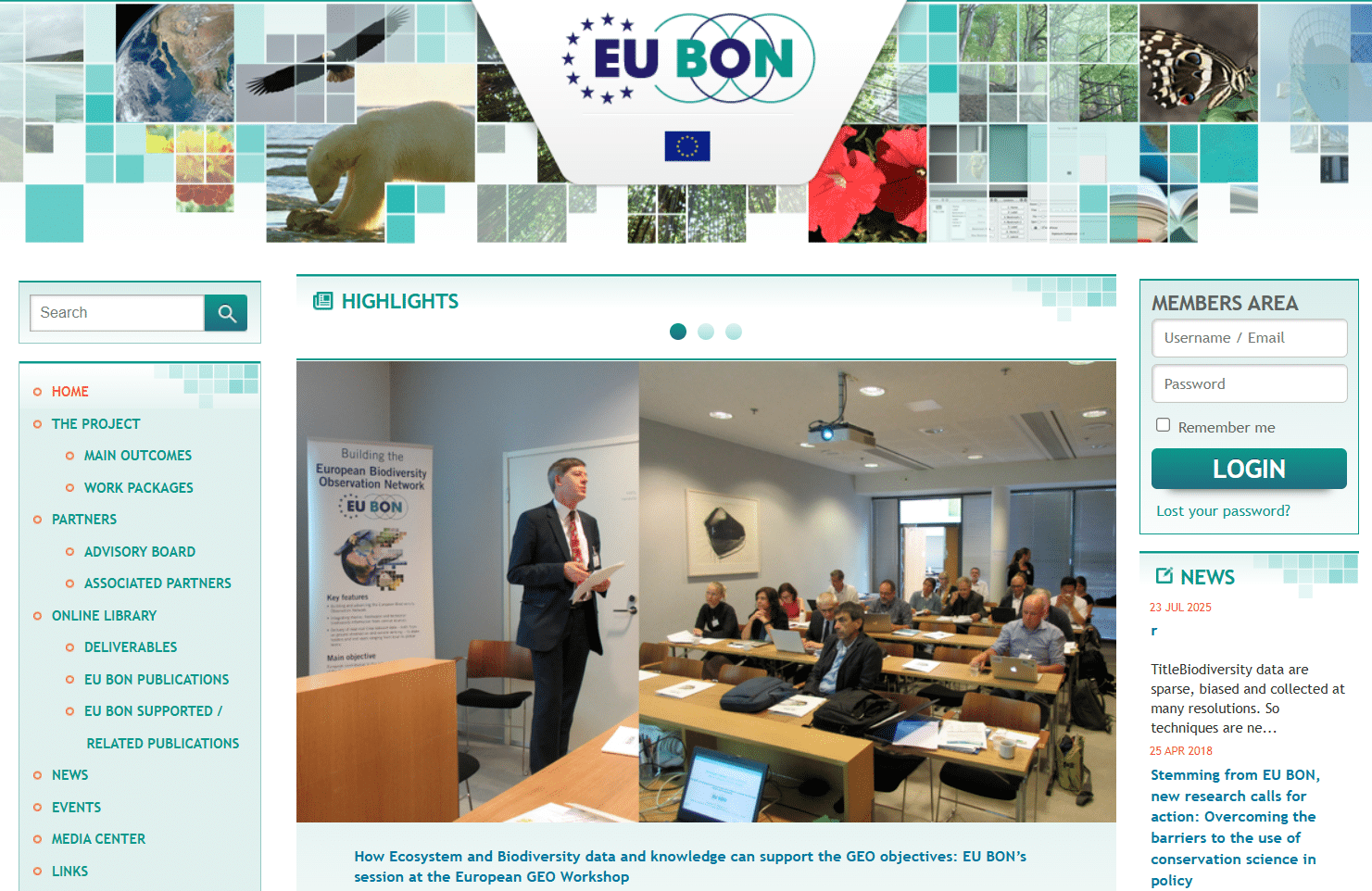
The EU BON project was launched to address this systemic challenge by creating a coordinated, standardized infrastructure to harmonize European biodiversity data and bridge the gap between scientific observation and environmental policymaking.
1. Project Profile
| Attribute | Details |
| Funding Programme | Seventh Framework Programme (FP7) |
| Project ID | 308454 |
| Consortium Size | 31 partners from 18 countries |
| Core Objective | Contribute to the Group on Earth Observations Biodiversity Observation Network (GEO BON) |
2. Project Scope: A “Network of Networks”
The fundamental philosophy behind EU BON was not to reinvent existing data collection efforts, but to integrate them. By adopting a “network of networks” approach, the project aimed to link distinct technological and social networks together.
The scope centered on two primary networks:
- The Social & Policy Network: Connecting communities of practice, citizen scientists, data managers, and policymakers to establish data sharing agreements and understand policy requirements (such as the EU Biodiversity Strategy and international IPBES reporting).
- The Technological Network: Developing interoperating IT infrastructures capable of storing, distributing, and analyzing disparate datasets—moving traditional biodiversity networks toward service-oriented cloud computing.
Key Focus Areas
- Data Harmonization: Establishing standard protocols to integrate on-ground taxonomic field observations with broad-scale satellite remote sensing data.
- Taxonomic Data Access: Overcoming barriers to data mobilization by supporting open-access platforms and standardizing documentation workflows.
- Predictive Modeling: Developing tools to track drivers of environmental change, prioritize conservation zones, and generate predictive ecosystem forecasts.
3. Key Deliverables
EU BON focused heavily on creating tangible web products, data standards, and strategic blueprints to optimize European data management.
- The European Biodiversity Portal: Serving as the central online hub, this platform functions as a library for data integration tools, visualization software, and derived environmental products. It connects data from heavyweights like the Global Biodiversity Information Facility (GBIF) and LifeWatch.
- Unified Data Standards & Integration Techniques: The development of technical architectures that allow real-time and near-real-time data to flow from local monitoring groups into international data layers.
- The “BON in a Box” Blueprint: A comprehensive toolkit designed to help individual regions or countries establish their own localized Biodiversity Observation Networks using tested, scalable strategies.
- Policy Assessment Tools: Practical indicators specifically designed for non-technical stakeholders in fields ranging from agriculture to local nature conservation, facilitating evidence-based decision-making.
4. Reporting & Impact Analysis
The final outcomes and data tracking reported by the EU BON consortium demonstrated a massive leap forward in Europe’s ecological data pipeline.
Improved Data Workflows
EU BON successfully optimized the entire biodiversity data lifecycle. By automating parts of the pipeline from initial data collection and standardization to the final open-access delivery, the time required to mobilize field data for policy use was significantly reduced.
Interoperability Breakthroughs
The project proved that distinct data layers—such as records of individual target organisms, habitat maps, and remote sensing imagery—could be cross-calibrated. This allows scientists to upscale local observations to evaluate whole-ecosystem trends, or downscale satellite data to predict species distributions on the ground.
Science-Policy Interface Support
The reporting frameworks built during EU BON directly supported national authorities facing reporting obligations under European environmental directives. By delivering timely, synthesized data, the network provided a solid foundation for upcoming IPBES global assessments and localized scenario developments.
Long-Term Legacy
The structural frameworks, metadata schemas, and workflows pioneered by EU BON laid the direct operational groundwork for modern EU initiatives. Its legacy continues to influence succeeding iterations of European ecological networks, ensuring that biodiversity monitoring shifts from a reactive model to a predictive, adaptive management system.