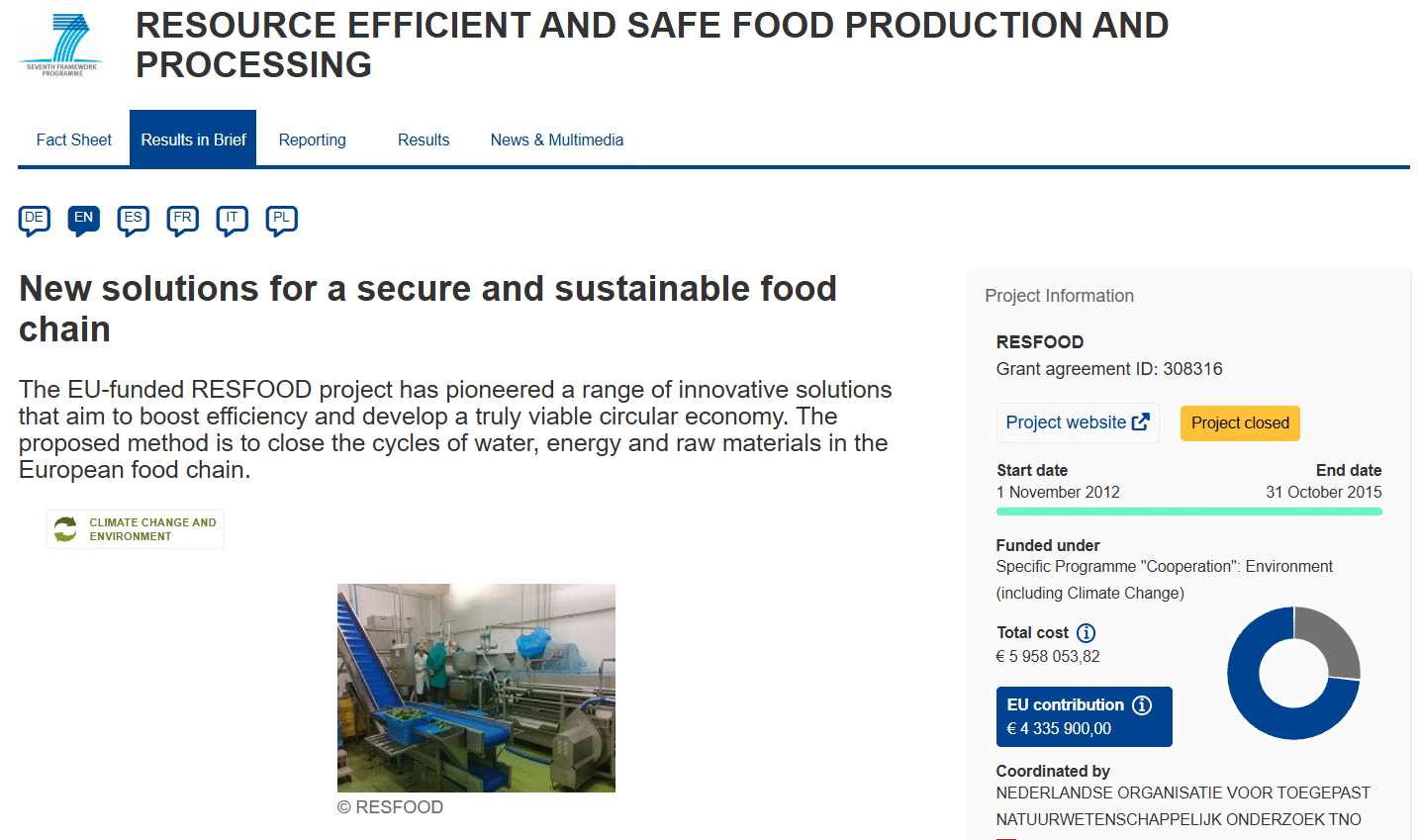
Featured Image: Project RESFOOD: New Solutions for a Secure and Sustainable Food Chain
Project Name: RESFOOD (Resource Efficient and Safe FOOD production and processing)
Source: EU CORDIS Project Website
On average, 44% of total water abstraction in Europe is consumed by agriculture alone. When combined with the fact that roughly one-third of all food produced globally goes to waste—taking vast amounts of embedded energy and nutrients with it—the need for a circular, highly optimized food supply chain becomes undeniable.
The EU-funded RESFOOD initiative was launched to pioneer a suite of high-tech solutions designed to close the loop on water, energy, and raw materials across European food production and processing, all while strictly safeguarding consumer health.
Project Scope: A Three-Pillar Approach
Led by the Netherlands Organisation for Applied Scientific Research (TNO) alongside a diverse consortium of industrial and academic partners, the scope of RESFOOD concentrated on three critical intervention points in the food value chain:
- Water Management in Horticulture: Improving water productivity in both traditional soil-based farms and high-efficiency soilless (hydroponic) cultivation systems.
- Resource Efficiency in Food Processing: Designing cutting-edge machinery and filtration loops to treat, sanitize, and endlessly reuse water in industrial produce washing lines.
- Waste Valorisation: Extracting high-value secondary compounds from agricultural side-streams and food processing bi-products before they ever reach a landfill.
Key Deliverables and Field Reporting
Instead of keeping innovations confined to laboratory benches, the RESFOOD project validated its technologies through full-scale industrial pilots and case studies across Europe. The key deliverables and their reported outcomes include:
1. Smart Irrigation & Crop Cultivation (Spain)
The team deployed tailored ICT solutions and optimized management software in the dry agricultural regions of Southern Spain. Field reports demonstrated that these smart irrigation frameworks made it possible to reduce water use per ton of product by over 40% in soil-based setups, with zero negative impacts on crop yield or quality.
2. High-Efficiency Wash Water Recycling (Netherlands)
At Vezet, one of the largest fresh-cut vegetable processors in the Netherlands, RESFOOD integrated an advanced automated filtration system. By combining Ultrafiltration (UF) membranes with targeted UV disinfection, the plant successfully recycled 50% of its industrial wash water safely back into the active production lines.
3. The Award-Nominated Mechanical Washer
In tandem with Spain’s National Center for Food Safety and Technology (CNTA), industrial manufacturing partner Kronen developed a brand-new, water-efficient washing machine for raw produce.
Performance Metric: The specialized mechanical washer successfully slashed direct water consumption from 1.8 liters per kilogram of produce down to just 1.3 liters per kilogram, earning a nomination for the prestigious Food Tech Innovation Award.
4. Rapid Biosensing & Microbial Profiling
To make large-scale water recycling viable, operators need instant confirmation that recycled loops are pathogen-free. RESFOOD delivered two major medical-grade breakthroughs:
- The IS-Pro Kit: Developed by partner Microbiome, this kit utilizes polymerase chain reaction (PCR) to detect all present bacteria variations simultaneously by analyzing DNA fragment lengths. It achieved full CE-IVD certification and successfully hit the commercial market.
- Optical Biosensors: Pioneered by Technion (Israel), this real-time optical sensing device provides rapid, on-site diagnostics for immediate bacterial detection in process water.
5. High-Value Compound Extraction
The project established eco-friendly extraction techniques to isolate valuable micronutrients from processing waste streams. Researchers proved that extracting delicate compounds like carotenoids, polyphenols, and terpenes from discarded food biomass is highly economically viable when managed alongside major organic processing.
Technical Performance Review
The cumulative field trials from the RESFOOD initiative established clear benchmarks for resource recovery across the sector:
| Intervention Area | Core Technology Deployed | Primary Resource Impact |
| Horticulture (Soil) | Sensor-driven ICT Irrigation Management | Over 40% reduction in water footprint |
| Hydroponic Growing | Closed-loop Nutrient Solution Recycling | Up to 40% reduction in fertilizer & water inputs |
| Produce Washing Line | Kronen Mechanical Outfeed Recycling | 27% reduction in direct mechanical water demand |
| Process Wastewater | Ultrafiltration (UF) + UV Disinfection | 50% decrease in total freshwater abstraction |
Interactive Eco-Efficiency Simulator
To see how integrating these RESFOOD technologies scales across an industrial facility, adjust the processing volume and technical choices in the planning simulator below.