Source:DRAGON CORDIS Project Sheet & Results|Montanuniversität Leoben Project Profile
Large-scale underground infrastructure projects—such as railway tunnels, subways, and subterranean power stations—generate hundreds of millions of tonnes of excavated rock and soil across Europe. Traditionally, nearly 100% of this muck material has been treated as industrial waste and hauled off to landfills. This conventional practice incurs high transport costs, strains land-use capacity, and generates significant carbon emissions, all while the construction sector simultaneously imports primary mineral resources for concrete production.
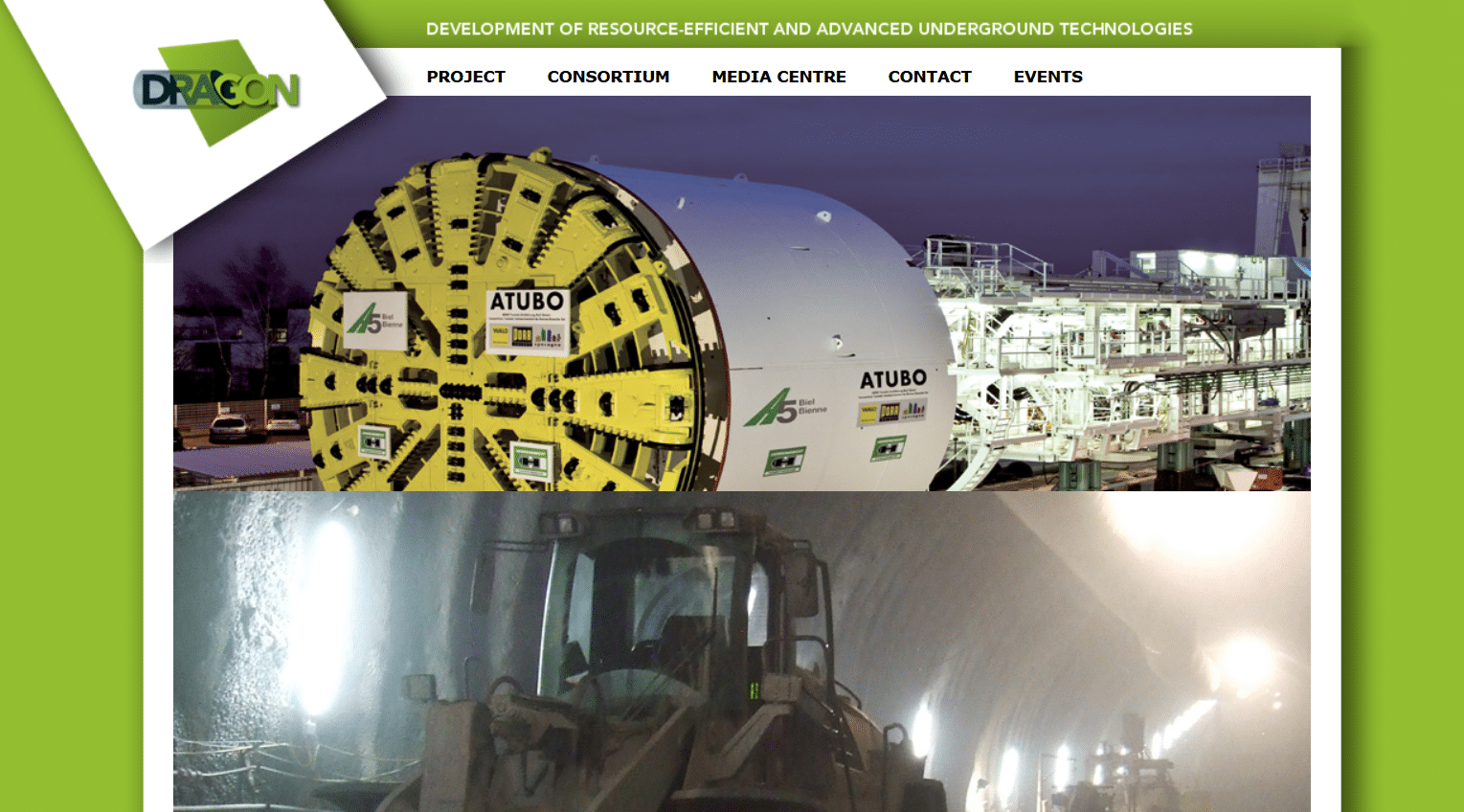
The DRAGON project was launched to disrupt this linear waste stream. By designing automated, high-speed sorting and analysis systems integrated directly onto Tunnel Boring Machines (TBMs), the project transformed tunnel excavation from a major waste-generating liability into an efficient, underground resource-mining operation.
1. Project Profile
| Attribute | Details |
| Funding Framework | Seventh Framework Programme (FP7) – Environment (ENV) |
| Grant Agreement ID | 308389 |
| Total Cost / EU Funding | €4,554,771 (EU Contribution: €3,243,659) |
| Project Duration | October 2012 – September 2015 (36 months) |
| Lead Coordinator | Univ. Prof. Robert Galler, Montanuniversität Leoben (Austria) |
| Key Industrial Partners | Herrenknecht AG (DE), PORR Bau GmbH (AT), B+G Concrete Technology (CH) |
2. Project Scope: Moving the Circular Economy Underground
The primary technical objective of DRAGON was to perform the entire material management chain—from initial rock characterization to final sorting and classification—completely underground, in real-time, right behind the excavation face.
Achieving this required solving a major engineering constraint: the material assessment framework could not slow down or interfere with the rapid advance rates of modern TBMs.
The project targeted several focus areas:
- In-Stream Analysis: Building automated sensors that could inspect high-volume, moving mass streams directly on the TBM’s main conveyor belts.
- Mineralogical Characterization: Distinguishing high-quality minerals (like clean limestone or quartz) from problematic materials (such as swelling clays or lithologies with a high mica content) that weaken concrete formulations.
- Industrial Reutilization: Aligning the properties of the sorted excavation material with the strict raw-material requirements of receiving industrial sectors, including concrete production, cement, steel, ceramics, and glass manufacturing.
3. Key Deliverables & TBM Integration
The DRAGON consortium successfully designed and field-tested an automated bypass sampling and in-stream classification system composed of five distinct prototype modules.
- Disc Cutter Load Monitoring System: Developed in partnership with Herrenknecht and Montanuniversität Leoben, this system uses thin-film piezo-elements and strain gauges mounted directly on the cutterhead tools. By measuring real-time mechanical deformation and load feedback, the system estimates rock hardness online during active drilling.
- Photo-Optical Grain-Size Analyzer: An automated imaging module that tracks the shape, fragmentation, and flakiness index of the continuous mass flow on the conveyor belt without halting operations.
- High-Precision Microwave Moisture Unit: A sensor suite designed to continuously calculate the changing water content of the muck material, which is critical for assessing whether the rock can be immediately repurposed for concrete.
- X-Ray Elemental Analysis Housing: A heavy-duty, protective underground enclosure housing advanced X-ray fluorescence units. This allows the system to run automated elemental and chemical analyses on material samples bypassed from the main stream.
- Underground Separation Plant: A dual-conveyor sorting configuration that routes the evaluated material in real-time based on sensor outputs, sending high-grade aggregates to storage for on-site tunnel lining construction and directing alternative minerals to industrial transport lines.
4. Reporting & Environmental Outcomes
Final pilot assessments and field evaluations—including component trials conducted at the factory of Herrenknecht and at the active Bossler rail tunnel site in Germany—demonstrated substantial environmental and financial benefits.
Radical Landfill Diversion
The final project reporting confirmed that the automated sorting system creates the potential to successfully reuse around 80% of all excavated tunnel material. This significantly helps alleviate the estimated 800 million tonnes of mineral waste projected from European subsurface expansion projects.
Positive Life Cycle Assessments (LCA)
Comprehensive Life Cycle Assessments conducted during the project verified that environmental indicators improve dramatically as material is diverted from landfills. The benefits are dual-pronged: they eliminate the localized land-use damage and pollution of massive landfill mounds while avoiding the carbon-heavy extraction of virgin primary resources.
Economic Transport Radii
DRAGON’s economic logistics modeling proved that the transport of these recycled minerals to external receiving factories is commercially viable and highly profitable within a 150 km radius. The system could allow excavation operations to generate an estimated additional €150 million annually across Europe by selling high-purity minerals to the concrete, steel, and glass sectors.
Policy Framework Guidelines
Beyond the physical hardware, the consortium published crucial legal analyses arguing for a harmonized, EU-wide end-of-waste directive. By establishing clear scientific standards for when excavated subsoil stops being legally classified as “waste” and starts being recognized as a “product,” the project laid the foundational framework for modern cross-border circular construction policies.