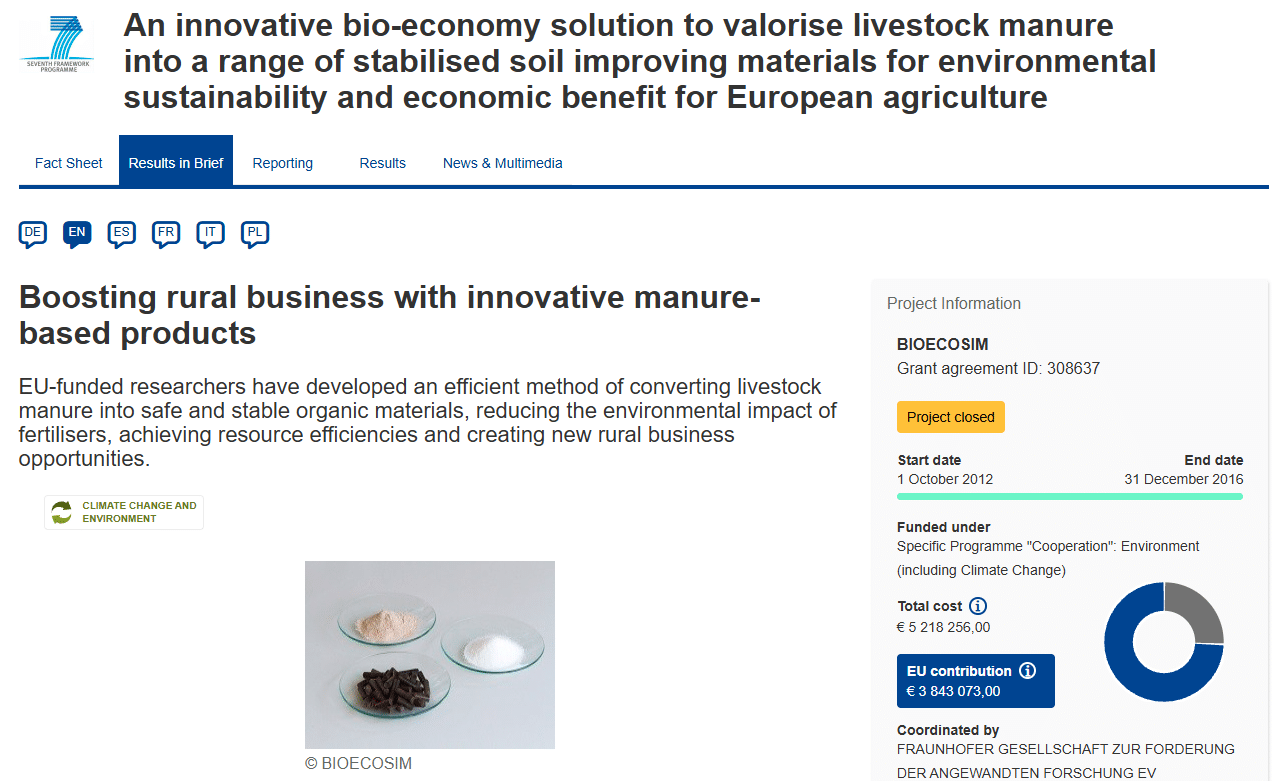
Source:BIOECOSIM CORDIS Fact Sheet|Fraunhofer IGB Project Page
Intensive livestock farming generates roughly 1,800 million tonnes of manure in Europe annually. In regions with dense agricultural operations, applying this volume directly to local fields causes severe nutrient saturation, leading to nitrate leaching and the eutrophication of vital water bodies. Concurrently, traditional crop cultivation remains heavily reliant on energy-intensive synthetic nitrogen and dwindling rock-mined phosphorus resources.
The BIOECOSIM project was engineered to resolve this imbalance. Coordinated by the Fraunhofer Institute for Interfacial Engineering and Biotechnology (IGB), the project developed an integrated, energy-efficient technological platform to process raw animal slurry right at its source, converting agricultural waste into standardized, pathogen-free mineral fertilizers and stable soil conditioners.
1. Project Profile
| Attribute | Details |
| Funding Framework | Seventh Framework Programme (FP7) |
| Grant Agreement ID | 308637 |
| Total Project Value | €5,218,256 |
| Project Duration | October 2012 – December 2016 |
| Lead Coordinator | Dr. Jennifer Bilbao, Fraunhofer IGB (Germany) |
| Strategic Focus | Resource-efficient technologies and circular bio-economy |
2. Project Scope: Decentralized Nutrient Upcycling
Raw liquid pig manure is composed of up to 90% water alongside indigestible feed solids, nitrogen (N), and phosphorus (P). Shipping raw manure from high-density livestock zones to distant arable farmlands that actually need nutrients is economically non-viable due to weight constraints.
BIOECOSIM focused on a decentralized, multi-stage modular approach. The objective was to design a system capable of handling manure directly on individual or cooperative farms to minimize transport logistics.
The technical scope targeted three core objectives:
- De-watering and Concentration: Isolating organic carbon components from liquid phases while keeping nutrients accessible.
- Thermal Conversions: Upgrading solid bio-waste into safe, stable organic soil amendments entirely free of weed seeds and dangerous pathogens.
- Chemical/Membrane Extraction: Separating individual dissolved inorganic ions from liquid fractions to create pure, predictable mineral fertilizer compounds.
3. Key Deliverables: The Technical Continuum
The primary deliverable of BIOECOSIM was an integrated, semi-industrial pilot demonstration plant composed of three core technological modules:
Module A: Pre-treatment & Solid-Liquid Separation
Raw manure is chemically conditioned using precise acidification to dissolve inorganic nutrients trapped within solid particles. The slurry then passes through a multi-stage filtration system that separates it cleanly into a phosphorus-depleted solid mass and a nutrient-rich liquid fraction.
Module B: Superheated Steam Drying & Pyrolysis
The isolated solid phase contains plant fibers and organic matter. This matrix is dried in an energy-efficient closed loop utilizing superheated steam. Following desiccation, the materials undergo pyrolysis at 450°C inside an oxygen-limited environment. This process converts the organic carbon into structural biochar, breaking down volatile contaminants and pathogens while preserving stable organic matter for long-term carbon sequestration.
Module C: Crystallization & Membrane Striping
The remaining liquid fraction is routed through a series of specialized recovery stages:
- Phosphate Precipitation: Phosphorus is recovered through controlled chemical precipitation, forming mineral crystals of calcium phosphate, magnesium phosphate, and magnesium ammonium phosphate (struvite).
- Ammonia Absorption: Nitrogen is selectively stripped using advanced gas-permeable membranes and combined with sulfuric acid to crystallize into pure ammonium sulfate.
- Water Reclamation: The final liquid output is low-nutrient, potassium-rich water safe enough to be utilized directly for localized crop irrigation or farm maintenance.
4. Reporting & Impact Analysis
The final validation and reporting cycles of BIOECOSIM verified the technical and commercial viability of the process through real-world operational benchmarks.
Radical Mass Reduction
Pilot operations successfully demonstrated that the system could process 50 kilograms of raw pig manure per hour. From this input, it synthesized:
- 500 grams of mineral phosphate fertilizer
- 500 grams of mineral nitrogen fertilizer (pure ammonium sulfate)
- 900 grams of organic biochar soil conditioner
The total combined mass of these highly concentrated end-products represents only 4% of the original raw manure volume, unlocking massive savings in shipping and storage expenses.
Agronomic Parity
Extensive greenhouse and field trials conducted across Germany and Spain confirmed that the recycled mineral salts and struvite mixtures operate on par with conventional fossil-based or synthetic chemical fertilizers. The plants demonstrated equivalent biomass yields without showing signs of heavy metal accumulation or toxicity.
Energy Self-Sufficiency
The pyrolysis phase naturally produces synthetic gas (syngas) alongside the biochar. System assessments verified that this syngas can be cleanly combusted to provide the thermal energy required for the upstream superheated steam drying modules, vastly improving the overall net-energy balance of the plant.
Market Integration
By providing verified blueprints for fully automated, low-maintenance modular assemblies, BIOECOSIM laid the direct technical foundations for commercial follow-up initiatives. The methodology proved that closing the regional nutrient loop can simultaneously protect local ecosystems from runoff while shielding farmers from the volatile pricing of imported global fertilizers.