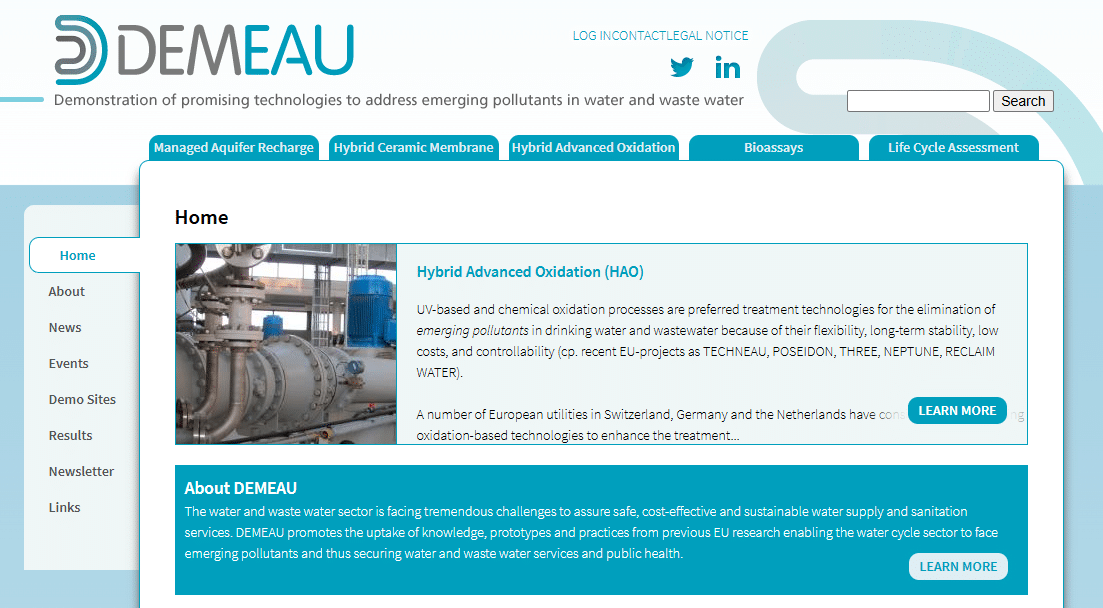
The detection of trace emerging pollutants (EPs)—ranging from everyday pharmaceuticals and cosmetics to complex industrial chemicals—presents a critical challenge for global water security. Traditional water treatment facilities often lack the capability to remove these microscopic threats. To bridge the gap between scientific innovation and industrial application, the European Union funded the DEMEAU project.
Project Reference: Demonstration of promising technologies to address emerging pollutants in water and waste water (FP7-ENV-308339). For comprehensive historical details and official summaries, visit theCORDIS Project Page .
The Project Scope
The primary objective of DEMEAU was to accelerate the market penetration and real-world deployment of promising water treatment technologies developed in previous EU research phases. Rather than inventing solutions from scratch, the project acted as a launchpad, moving prototypes from the lab into full-scale industrial operations through collaboration with 17 consortium members across European utilities, research institutes, and innovative small-to-medium enterprises (SMEs).
The project’s scope centered tightly on demonstrating four technological pillars:
- Managed Aquifer Recharge (MAR): Utilizing natural underground filtration and storage mechanisms to naturally degrade pollutants during periods of high water availability.
- Hybrid Ceramic Membrane Filtration (HCMF): Deploying highly stable ceramic membranes that offer superior mechanical resistance and a longer operational lifespan than state-of-the-art polymeric materials.
- Hybrid Advanced Oxidation Processes (AOP): Combining ozone, hydrogen peroxide, and ultraviolet (UV) light to break down resilient chemical bonds in complex mixtures.
- Bioassays: Implementing effect-based biological screening tools to assess total water toxicity, allowing utilities to detect unknown harmful substances that chemical analysis alone might miss.
Key Project Deliverables
DEMEAU focused heavily on transferring applied knowledge directly to the entities managing civic infrastructure. Its key deliverables were designed to eliminate regulatory, technical, and economic barriers:
- Technology Brochures & Toolboxes: A comprehensive series of technical handbooks tailored for water utility operators, associations, and technology suppliers outlining design standards and engineering configurations.
- Environmental & Cost Assessments: Complete Life Cycle Assessments (LCA) and Life Cycle Costing (LCC) frameworks to scientifically prove the long-term economic viability and low carbon footprint of the new solutions compared to legacy treatments.
- The Decision Support Tool: An interactive framework developed to help utility managers evaluate their localized water composition and pick the optimal treatment line from the evaluated options.
- Policy & Authorization Frameworks: Drafted regulatory guidelines aimed at European and national standardization bodies (such as DIN/ISO and the OECD) to streamline compliance for reclaimed water.
Project Reporting: Key Results & Practical Impacts
The final project reporting highlights several significant breakthroughs that have significantly shaped modern European water infrastructure and environmental standards:
1. Advanced Oxidation & Energy Savings
The project successfully developed and demonstrated an innovative, energy-efficient UV reactor designed to neutralize persistent trace organic compounds. In full-scale utility evaluations, this redesigned system achieved a 30% to 40% reduction in energy consumption compared to standard contemporary UV reactors, eliminating a major financial barrier to deployment.
2. Full-Scale Launching Sites
DEMEAU helped establish vital reference locations for future infrastructure development. Notably, the project’s work on advanced oxidation technologies supported the implementation at the WWTP Neugut in Switzerland. This became the first large-scale municipal wastewater plant in Switzerland to feature a dedicated, specialized ozonation step, serving as an engineering blueprint for approximately 100 plants scheduled for upgrades over subsequent decades.
3. Bioassay Validation and Trigger Values
The project successfully validated a unified panel of in vitro bioassays capable of screening for endocrine disruptors, genotoxic agents, and acute cellular toxins. Critically, researchers derived specific biological effect trigger values. If water samples cross these thresholds, it indicates a potential risk to human or ecosystem health, providing a reliable early-warning mechanism.
4. Regulatory Integration
The data and methodologies perfected during the three-year lifecycle of the project directly informed subsequent European legislation, notably the standards surrounding the EU Water Reuse Regulation. By embedding bioassays into chemical monitoring frameworks, the project gave regulators a template for holistic, safety-first water quality assurance.