Featured Image: Click here to view the EXPOSOMICS External-Internal Data Fusion Framework
Project Citation Source: CORDIS Project Archive – European Commission (Grant ID: 308610)
Introduction
While genetics provide the basic blueprint for human biology, environmental exposures—the air we breathe, the water we drink, and the environments we inhabit—are responsible for the vast majority of chronic non-communicable diseases. Historically, environmental health science struggled with a major data fragmentation problem, assessing risk through an oversimplified “one exposure, one disease” perspective that relied on static, macro-level regional pollution models.
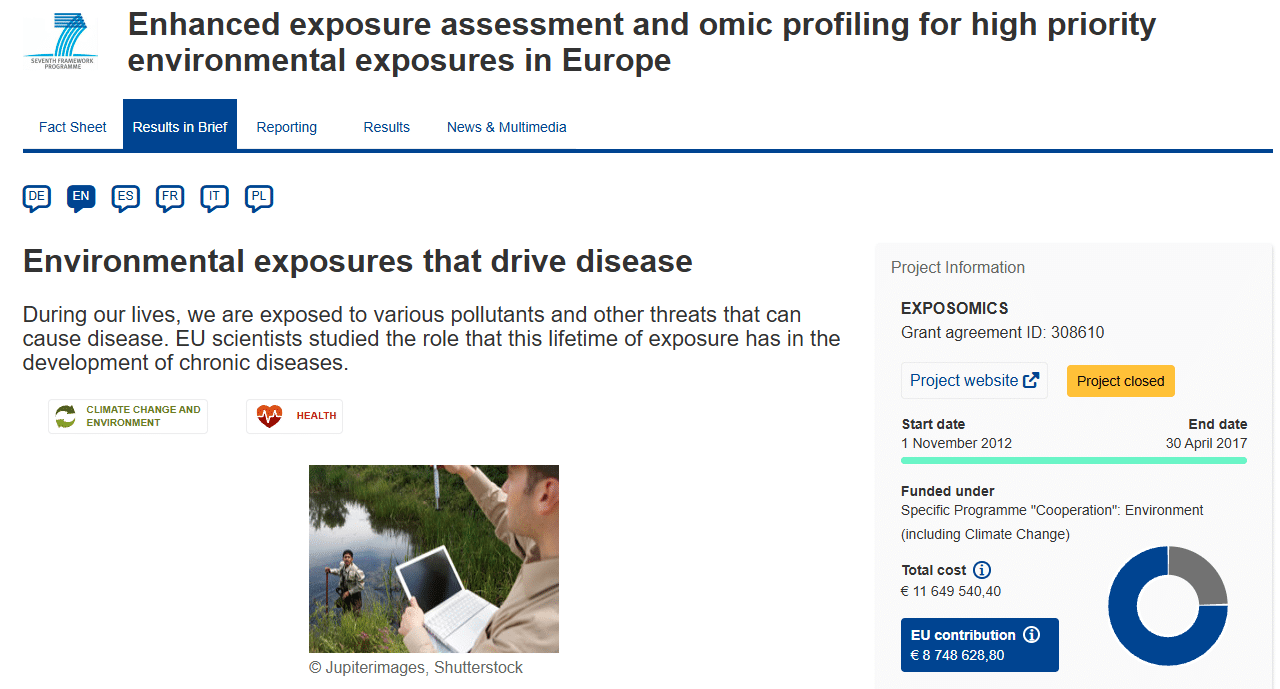
To fundamentally redefine this paradigm, the European Union established the EXPOSOMICS project (“Enhanced exposure assessment and omic profiling for high priority environmental exposures in Europe”). Funded under the European Commission’s Seventh Framework Programme (FP7), this multi-million euro collaborative project aimed to map out the “exposome”—a concept representing the totality of an individual’s environmental exposures from conception onwards, including its external components and internal biological fingerprints.
Project Scope: Bridging the External and Internal Exposome
The core scope of the EXPOSOMICS initiative was to develop and validate a breakthrough approach to exposure science by linking precise, individual-level environmental tracking data with high-throughput molecular profiles. The project specifically targeted two high-priority environmental vectors: ambient air pollution (particulate matter like $PM_{2.5}$ and $PM_{10}$, ultra-fine particles, and $NO_2$) and drinking water contaminants (such as disinfection by-products).
Rather than relying on vague geographical averages, EXPOSOMICS studied these stressors during critical, vulnerable periods of human life—including in utero, childhood, and adulthood—using an inter-generational epidemiological study design.
“The ultimate goal of EXPOSOMICS was to introduce ‘Exposome-Wide Association Studies’ (EWAS), mimicking the agnostic, data-driven methodology of genomics to identify completely new molecular mechanisms of environmental disease.”
Key Methodological Frameworks
- The “Meet-in-the-Middle” Approach: A dual-directional analytical framework. One arm tracks forward from individual external exposure to internal biomarkers, while the other tracks backward from clinical disease states to identify early molecular alterations. They meet in the middle to establish clear, undeniable causal links.
- Life-Course Epidemiology: Integrating data across short-term experimental human studies and massive, long-term European birth and adult population cohorts to evaluate the cumulative “chain of risk.”
Core Technologies & Key Deliverables
Coordinated by Imperial College London and pulling together a world-class consortium of exposure scientists, epidemiologists, and bioinformaticians, EXPOSOMICS delivered an integrated technical ecosystem to measure environmental impact with high fidelity:
| System / Deliverable | Technical Functionality | Primary Application |
| Personal Exposure Monitoring (PEM) | A sensor network blending wearable air monitors, smartphones, satellite remote sensing, and GIS databases. | Capturing real-time individual exposure to air pollution during daily transit |
| Multi-Omics Profiling Pipeline | High-throughput molecular analysis of blood, urine, and exhaled breath condensate (metabolomics, adductomics, transcriptomics, and epigenetics). | Mapping internal molecular changes and biological responses |
| Next-Gen Exposure Assessment Tools | Advanced statistical and bioinformatic models designed to disentangle complex chemical mixtures. | Adjusting for measurement errors and isolating specific risk factors in multi-pollutant zones |
| Adverse Outcome Pathways (AOPs) | Systematic biological flowcharts mapping initial molecular triggers to eventual tissue and organ failure. | Clarifying the biological plausibility of environmental cardiovascular and respiratory diseases |
Project Reporting & Scientific Insights
The reporting and validation phases of EXPOSOMICS yielded massive, peer-reviewed data repositories that continue to reshape public health regulations across the European Union:
- Drastic Reduction in Exposure Uncertainty: By replacing crude regional residential address data with dynamic, smartphone-enabled PEM tracking, the project proved that traditional models frequently misclassify individual exposure. The new individualized data vastly minimized measurement errors, providing highly accurate disease risk estimations.
- Discovery of Low-Exposure Biomarkers: The multi-omics screens successfully isolated specific metabolic and epigenetic signatures in blood samples that fluctuate even under low, regulatory-compliant levels of air pollution. This provided early warning signs of systemic inflammation and oxidative stress long before clinical symptoms appear.
- Cracking the “Mixture” Problem: While historical toxicology struggled to evaluate how different chemicals interact, the project’s EWAS frameworks demonstrated that combinations of air particulates and water contaminants trigger overlapping inflammatory pathways, magnifying cardiorespiratory vulnerabilities.
- The “Biological Reserve” Concept: Long-term tracking data reinforced that early-life exposures (including prenatal conditions) fundamentally shape an individual’s biological reserve—the underlying resilience a body has to withstand environmental strains later in life.
By engineering a functional bridge between mobile sensor technology and state-of-the-art molecular biology, EXPOSOMICS established the scientific foundation required for advanced, cost-effective environmental regulation and personalized preventive medicine.