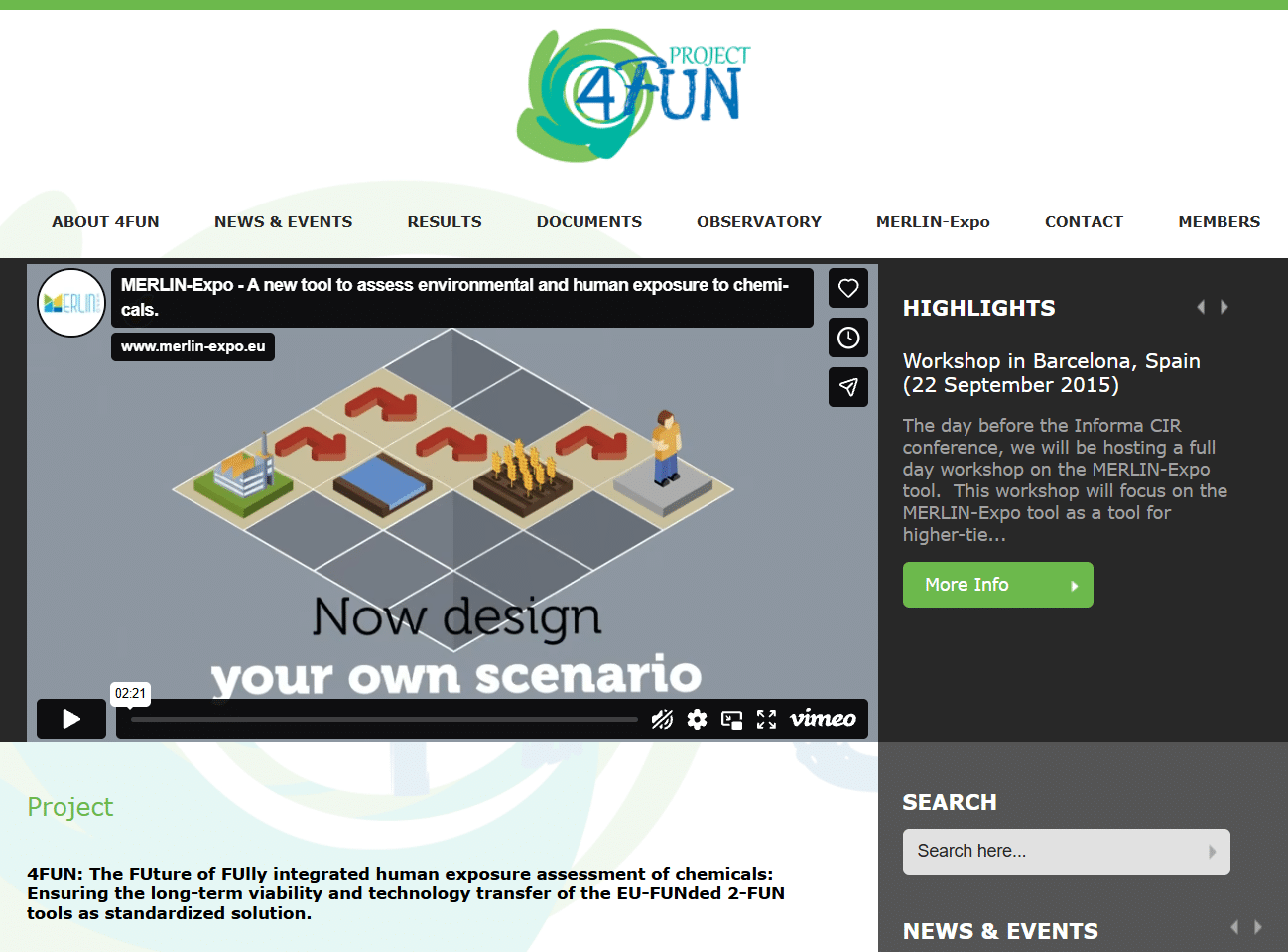
Evaluating how chemicals impact human health has historically been a fragmented process. Historically, scientists used one tool to model how a chemical spread through water, another for soil, and an entirely separate workflow to estimate how it accumulated in human organs.
The EU-funded project 4FUN was launched to bridge these gaps. Building on the foundational work of the earlier 2-FUN project, 4FUN transformed complex exposure science into an accessible, standardized tool for regulatory and industry use.
- Official Source: EU CORDIS Project Page (Grant ID: 308440)
- Software Platform: MERLIN-Expo Platform
The Project Scope: Eradicating Fragmented Risk Assessment
The primary objective of 4FUN was to solve the long-term viability and technology transfer of integrated exposure tools. Prior to 4FUN, highly sophisticated exposure models frequently died in the “academic valley of death”—software developed during multi-million euro grants was left unmaintained once funding ceased.
4FUN took the multi-media, full-chain models built in the 2-FUN project and subjected them to rigorous software engineering, standardization, and real-world validation. The scope centered on three pillars:
- Integration: Linking environmental fate models with human internal dose models in a single user interface.
- Standardization: Establishing standard documentation in collaboration with the European Committee for Standardization (CEN) to give regulators confidence in the software’s math.
- Sustainability: Designing a business and distribution model ensuring the software remained free, open-source, and actively maintained for long-term use.
Key Deliverables: Inside the MERLIN-Expo Suite
The crown jewel deliverable of the 4FUN project is the MERLIN-Expo software platform. This free computational tool simulates a “full-chain” exposure pathway, charting a chemical’s journey from an industrial release point all the way into human tissues.
The suite functions via a series of interconnected, modular libraries categorized across two primary disciplines:
1. Environmental & Biota Compartments
The software models how contaminants partition and break down across diverse physical and biological matrixes:
- Physical Media: Surface water, atmosphere, soil, and groundwater systems.
- Biota Media: Aquatic organisms, agricultural plants, and terrestrial mammals.
2. Human Internal Dosimetry
Instead of simply calculating external exposure (e.g., milligrams of a chemical inhaled per day), MERLIN-Expo features a lifetime Physiologically Based Pharmacokinetic (PBPK) model. This component simulates the classic ADME processes (Absorption, Distribution, Metabolism, and Excretion) inside the human body over a lifetime, offering highly accurate predictions of active chemical levels inside specific organs.
Project Reporting & Validation Performance
To prove its worth, the 4FUN consortium subjected MERLIN-Expo to strict validation studies using real-world human biomonitoring (HBM) data.
One prominent benchmark study tracked human exposure to heavy metals and organic pollutants around a modern solid waste incinerator in Northern Italy. The findings highlighted clear practical trade-offs for risk managers:
| Metric Evaluated | Performance Insights | Takeaway for Risk Analysts |
| Early-stage screening | High efficiency. Drastically reduced time and budget requirements compared to standard piecemeal modeling pipelines. | Excellent for rapid, cost-effective initial tier evaluations. |
| Dietary input accuracy | Highly sensitive. For example, Lead (Pb) predictions in urine matched real-world data perfectly only when highly precise local dietary intake data was provided. | The software is only as good as its input data; generic defaults degrade accuracy. |
| Blood compartment dynamics | Moderate tracking. The PBPK equations occasionally struggled to capture rapid fluid dynamics within active human blood compartments over volatile periods. | Best used for long-term lifetime body-burden estimations rather than immediate acute poisoning timelines. |
CEN Standardized Solution: Beyond the software code itself, a major final reporting success was the delivery of a formalized model evaluation framework with CEN. This provides a repeatable checklist for expert judgment, scoring multimedia exposure models against regulatory applicability frameworks to ensure long-term trust under EU chemical safety legislation.