Every year across Europe, civil excavation teams accidentally strike underground gas pipelines, power lines, and fiber-optic cables over 90,000 times. When using Horizontal Directional Drilling (HDD)—a “trenchless” method used to install pipes without tearing up streets—operators are effectively flying blind. Standard ground-penetrating radar (GPR) operated from the surface often misses deep, non-metallic targets like plastic water mains or clay sewers.
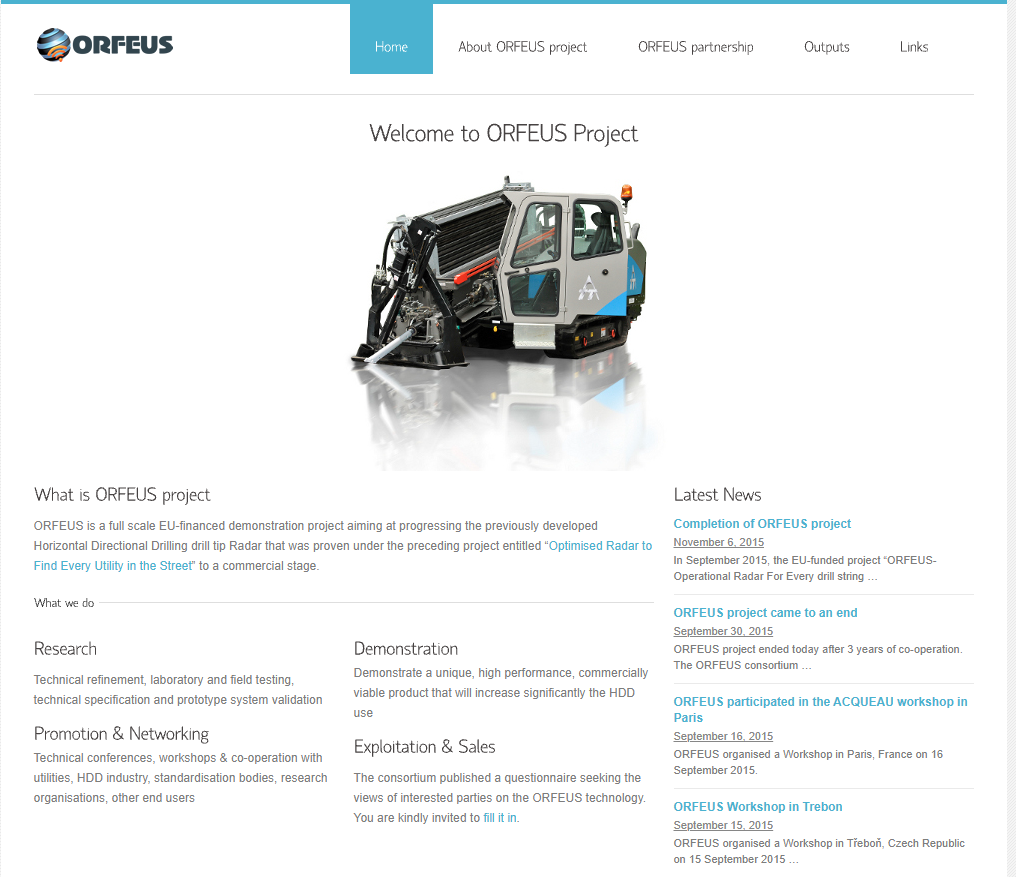
To take the guesswork out of trenchless excavation, the EU funded ORFEUS (Operational Radar For Every drill string Under the Street). Building on a previous proof of concept, this full-scale demonstration project successfully embedded a live, look-ahead radar system directly into a spinning, subterranean drill bit.
- Official Source: EU CORDIS Project Page (Grant ID: 308356)
The Project Scope: Navigating the Subsurface Labyrinth
The primary mission of ORFEUS was to elevate a rough “drill-tip radar” prototype up to commercial readiness (Technology Readiness Level 7). The project targeted the intense urban congestion of modern utilities, where standard mapping records are notoriously missing or inaccurate.
Developing a radar that operates on a surface lawn is one thing; putting it inside a drill tip is an engineering nightmare. The scope of the project was centered around solving three harsh physical constraints:
- Collision Avoidance: Developing ultra-wideband (UWB) radar antennas capable of “looking” both ahead of and around the bore-head to alert operators before a strike happens.
- Data & Power Telemetry: Designing a reliable transmission pathway to send massive streams of raw radar data up a rotating drill string to the surface display.
- Harsh Environment Survivability: Ensuring delicate electronics could survive immense mechanical vibration, torque, and the flow of pressurized bentonite clay slurry (drilling mud).
Core Deliverables & Technical Architecture
The project successfully delivered a working hardware-and-software suite retrofitted onto commercial HDD rigs. The system relies on a few tightly integrated components:
1. The Bore-Head GPR Assembly
The radar is housed directly inside the steerable bore-head. It utilizes specialized, angled UWB antennas and an electronic 3-axis gyroscope to track the drill bit’s exact rotational orientation (roll angle). This allows the radar to know exactly whether a detected obstacle is above, below, or to the side of the bit.
2. Spread-Spectrum Drill String Interconnects
Standard wireless telemetry cannot penetrate deep soil or muddy water at high bandwidths. ORFEUS delivered a proprietary electrical transmission line built right into the inter-section joints of individual drill rods. As the operator screws a new rod into the drill string, the internal electrical connectors mate automatically, maintaining an active power supply from the surface down and a high-bandwidth digital pathway back up.
Field Reporting & Validation Performance
To validate the technology under real-world conditions, the ORFEUS consortium conducted live field trials across three European countries: Germany, France, and Slovenia. Rigs were deployed to lay roughly half a kilometer of new pipeline across varied soil conditions and real urban layouts.
The operational results from final project reporting demonstrated clear performance boundaries:
| Technical Attribute | Field Trial Performance Metric | Operational Impact |
| Detection Range | 50 to 100 centimeters in front of and around the bore-head (highly dependent on soil moisture and clay content). | Provides a critical 1-meter safety buffer to halt or divert the drill path before hitting an obstacle. |
| Target Resolution | Successfully distinguished multiple distinct targets when separated by at least 300 millimeters. | Allows operators to safely thread the needle between closely packed utility conduits. |
| Minimum Object Size | Located linearly shaped objects down to 10 millimeters across the longest cross-section. | Capable of picking up narrow, thin fiber-optic lines or minor service pipes. |
| Telemetry Range | Maintained stable data and power connections across a total drill string length of up to 100 meters. | Validated the system for standard neighborhood utility installations. |
Real-World Incident Avoidance: During the pilot deployment in Slovenia, the live radar display alerted the crew to an undocumented obstacle directly in the drill path. Upon inspection, it was revealed to be a live, unmapped high-voltage electricity cable. The system successfully prevented what would have been a catastrophic utility strike and a severe safety hazard for the crew.
Standardizing the Solution
To guarantee market viability, the consortium didn’t just build hardware—they partnered with the German Standardization Organisation (DIN) to publish DIN SPEC 91322. This established the formal regulatory baseline for how bore-head radar environments, operational limits, and safety metrics are assessed in the trenchless construction sector moving forward.