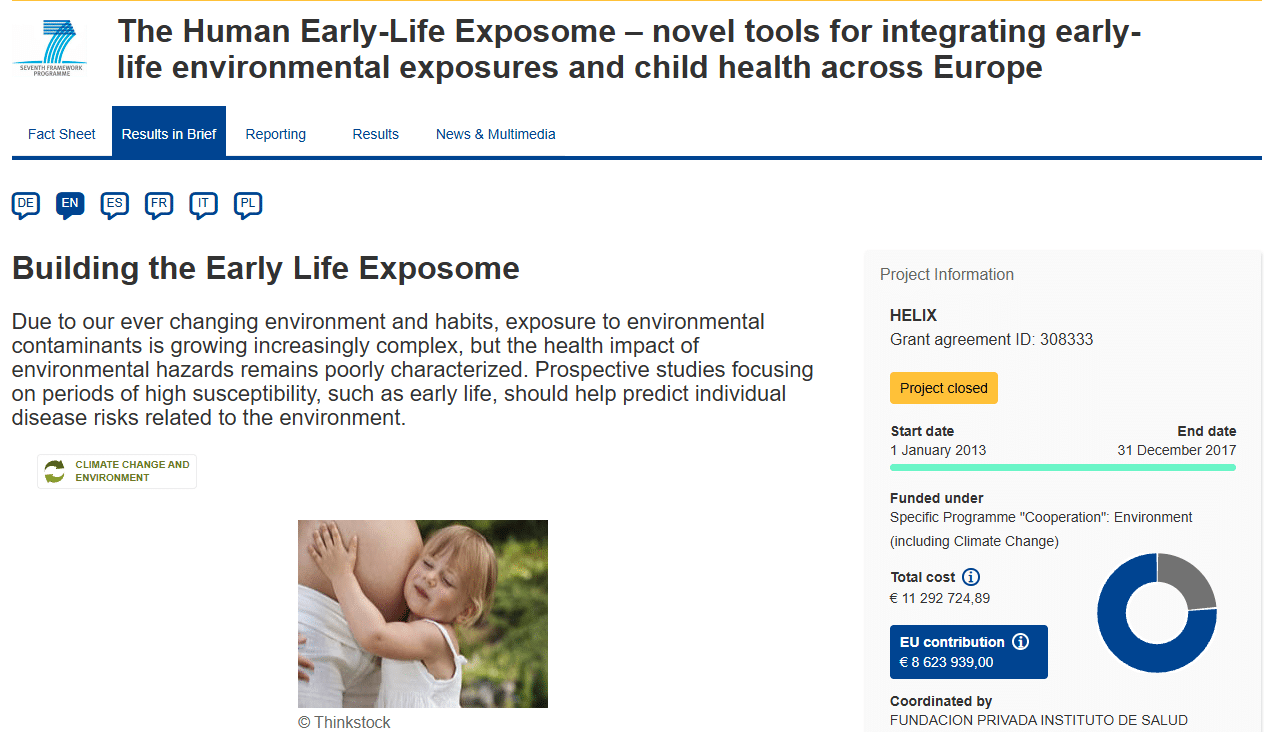
Project Citation Source: CORDIS Project Archive – European Commission (Grant ID: 308333)
Introduction
Pregnancy and early childhood represent windows of intense biological vulnerability. During these developmental periods, rapidly growing organs, changing metabolic systems, and a higher relative breathing and consumption rate per kilogram of body weight mean that children are highly susceptible to environmental hazards. According to the Developmental Origins of Health and Disease (DOHaD) hypothesis, disruptions during these early windows can permanently alter structural physiology and metabolic functions, carrying lifelong consequences into adulthood.
To comprehensively address these multi-layered risks, the European Union launched the HELIX project (“The Human Early-Life Exposome – novel tools for integrating early-life environmental exposures and child health across Europe”). Funded under the European Commission’s Seventh Framework Programme (FP7) with a budget of €8.6 million, this landmark collaborative study brought together 13 international partners to capture the “early-life exposome”—characterizing the totality of non-genetic chemical, physical, and urban exposures from conception through childhood.
Project Scope: A Multi-Cohort Longitudinal Framework
The primary scope of HELIX was to break away from traditional “single-exposure” epidemiology and build a synchronized, multi-dimensional database capable of characterizing the early-life environmental landscape.
The project strategically harnessed data from six established population-based longitudinal birth cohorts across Europe, standardizing information across very different geographic and socio-cultural settings:
- Born in Bradford (BiB) — United Kingdom
- EDEN — France
- INMA (Infancia y Medio Ambiente) — Spain
- KANC — Lithuania
- MoBa (Norwegian Mother, Father and Child Cohort Study) — Norway
- Rhea — Greece
By harmonizing data from approximately 30,000 mother-child pairs within these existing frameworks, HELIX systematically traced multiple exposure profiles during pregnancy and childhood, directly linking them to molecular changes and long-term childhood development.
“By integrating individual mobility data with deep molecular omics, HELIX shifted the focus from broad residential averages to the actual chemical and physical reality experienced by a developing child.”
Core Infrastructure & Key Deliverables
Coordinated by the Barcelona Institute for Global Health (ISGlobal), HELIX successfully combined high-tech mobile monitoring tools, advanced geospatial mapping, and high-throughput laboratory techniques into three distinct deliverables:
| Infrastructure Level / Deliverable | Technical Functionality | Key Research Targets |
| Geospatial & Urban Database | Automated mapping of outdoor ambient air pollution ($PM_{2.5}$, $PM_{10}$, $NO_2$), noise levels, UV radiation, localized temperature, and access to built environments/green spaces. | Pregnancy and childhood macro-level external exposures |
| Individual Panel Assessment | Deploying personal smartphones and wearable sensors to collect real-time data on mobility, physical activity, and immediate physical exposures across active sub-cohorts. | Dynamic individual external exposure variation |
| Child Multi-Omics Warehouse | A massive biological repository profiling blood and urine samples from 1,200 deeply characterized mother-child pairs using metabolomics, proteomics, transcriptomics, and DNA methylation. | Internal exposome molecular signatures and biomarkers |
| Exposome Statistical Toolkit | Development of innovative multi-exposure regression and covariate models designed to isolate true predictors from highly correlated environmental mixtures. | Eliminating statistical noise and exposure misclassification |
Project Reporting & Scientific Milestones
The extensive reporting and validation phases of the HELIX initiative established a vital database for child health policies and urban planning guidelines across Europe:
- Pioneering Harmonized Data Architecture: HELIX demonstrated that it is entirely possible to construct an early-life exposome database combining fully comparable biomonitoring, geospatial data, and child health outcomes across distinct sovereign nations.
- Mapping the Triple Phenotype Threat: The project confirmed strong, statistically validated links between heavy multi-pollutant exposure mixtures and negative child health trends across three primary clinical areas: cardiomedabolic health (elevated blood pressure and childhood obesity), respiratory and immune systems (increased asthma rates), and altered neurodevelopment.
- Overcoming Covariate Multi-Collinearity: Traditional statistics struggle when evaluating multiple overlapping inputs (e.g., separating the health impact of high traffic noise from adjacent traffic exhaust). HELIX successfully engineered and published cutting-edge statistical techniques capable of separating highly correlated covariates to identify specific, root-cause environmental stressors.
- The Foundation for Future Initiatives: The harmonized methodologies and deep data warehouse built during HELIX provided the core infrastructure for successor European networks, including the European Human Exposome Network (EHEN) and the ATHLETE project, which continue to follow these cohorts into adolescence and young adulthood.
By successfully linking urban landscapes, personal chemical exposure, and internal molecular signatures, HELIX provided European policymakers with the concrete, evidence-based tools required to engineer safer, healthier, and more resilient environments for the next generation.
References
Agier, L., Portengen, L., Chadeau-Hyam, M., et al. (2016). A systematic comparison of statistical methods for exposome-wide association studies. Epidemiology, 27(2), 247-255.
European Commission. (2018). The Human Early-Life Exposome – novel tools for integrating early-life environmental exposures and child health across Europe (HELIX). CORDIS Final Report Summary. Grant Agreement ID: 308333.
Vrijheid, M., Slama, R., Robinson, O., et al. (2014). The Human Early-Life Exposome (HELIX): Project Rationale and Design. Environmental Health Perspectives, 122(6), 535-544.