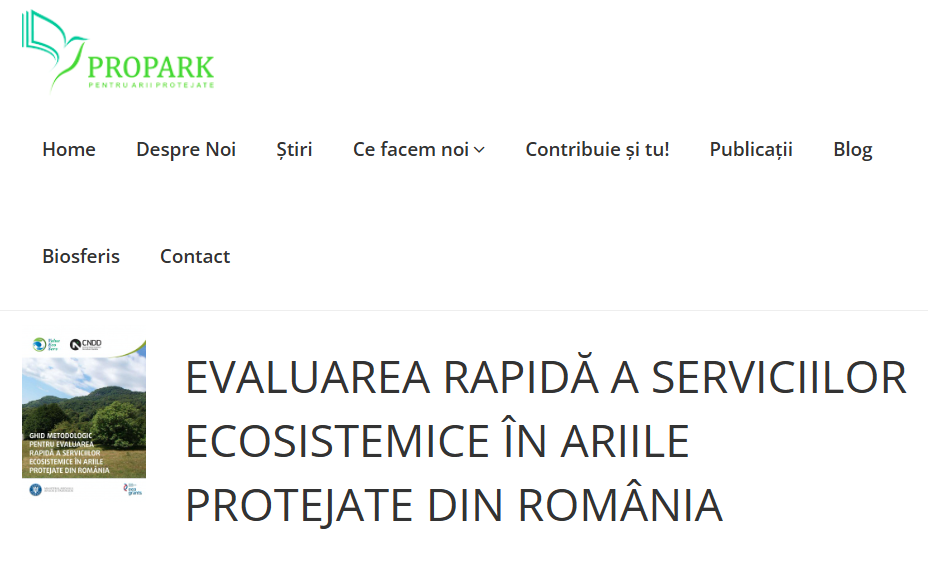
Featured image credit: Product by the ProPark Foundation / ValueEcoServ project, source: ProPark
ValueEcoServ is a Romanian project focused on evaluating ecosystem services in protected areas. It was implemented by the National Centre for Sustainable Development and supported through a grant from Iceland, Liechtenstein, and Norway under Romania’s Biodiversity and Ecosystem Services Programme. The project produced a practical methodological guide for rapid ecosystem service assessment, with an emphasis on using a simple, fast, and relatively low-cost approach.
What ValueEcoServ Is
ValueEcoServ was created to help identify and assess the ecosystem services provided by protected areas in Romania. The project recognized that evaluating ecosystem services can be methodologically difficult, especially when the goal is to assess many ecosystems in a short time.
To address that challenge, the project team developed a rapid assessment method based largely on input from social actors and beneficiaries of ecosystem services. That made the approach more practical for field use and more suitable for decision-making in conservation and protected-area management.
Why It Matters
The project matters because protected areas provide many benefits beyond biodiversity conservation alone. They support recreation, water regulation, carbon storage, landscape value, and other ecosystem services that contribute to human well-being.
By making these services visible, ValueEcoServ helps decision-makers understand the broader value of protected areas. That is important for land-use planning, conservation funding, and public policy, because ecosystem services are often overlooked when ecosystems are discussed only in ecological terms.
How the Method Works
The guide developed through ValueEcoServ describes a three-step process. First, it identifies ecosystem services through sociological surveys and group discussions with stakeholders. Second, it evaluates the social importance of those services and ranks them using opinion surveys, group debate, and a relevance index.
Third, it estimates monetary value by choosing a reference ecosystem service, assigning a value to it, and then calculating total use and non-use values across the site. This combination of participatory and economic methods makes the assessment more grounded in local realities while still producing results that can support policy and management.
Connection to Ecosystem Services
ValueEcoServ is part of a larger international trend that treats ecosystem services as essential inputs to human well-being and decision-making. The project fits within the same broad framework used by the Millennium Ecosystem Assessment and later ecosystem-service valuation work.
In this sense, ValueEcoServ is not just a local technical exercise. It is part of the effort to translate ecosystem-service concepts into practical tools that can help governments and conservation actors make better choices about nature, land use, and development.
Why It Is Useful
The main value of ValueEcoServ is that it offers a more accessible way to assess ecosystem services in protected areas. Traditional valuation methods can be complex, costly, and slow, while this project aimed to make the process faster and more usable in real planning contexts.
That makes the project useful for managers, policymakers, and researchers who need a realistic method for understanding what protected areas provide to people. It also helps build public awareness by showing that ecosystems generate measurable social and economic value, not just environmental benefits.