Featured image credit: Product by the European Commission, source: EU Climate Action – Long-term strategy for 2050
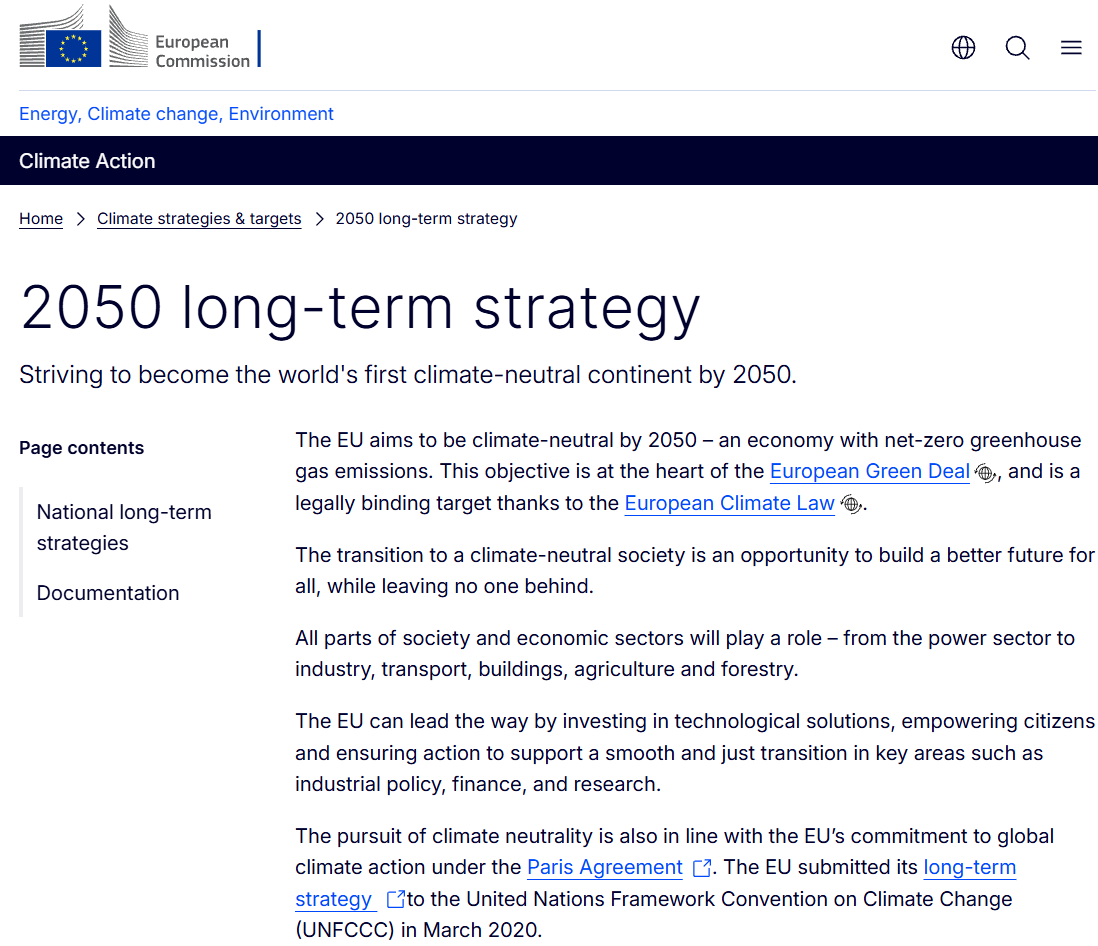
The EU’s 2050 low-carbon economy strategy is the long-term plan that guides Europe toward climate neutrality by 2050. It is built around the idea of a net-zero greenhouse gas economy, where emissions are reduced as much as possible and any remaining emissions are balanced by removals.
What the strategy means
The European Commission presents the 2050 strategy as part of the European Green Deal and now legally anchored through the European Climate Law. In simple terms, it is the EU’s roadmap for transforming energy, industry, transport, buildings, agriculture, and forestry into a climate-neutral system.
The strategy was developed to show how Europe can cut emissions by 80 to 95% by 2050, which was the earlier long-term benchmark for advanced economies. Over time, this vision evolved into the stronger and now binding objective of climate neutrality by 2050.
Why it matters
This strategy matters because it sets the direction for all major climate and energy policies in the EU. Instead of treating climate action as a short-term policy cycle, it creates a long-term framework for investment, infrastructure, regulation, and innovation.
It also matters because the transition is not only environmental but economic. The Commission frames climate neutrality as an opportunity to build a more modern, competitive, and resilient economy while supporting a just transition for citizens and regions. That makes the strategy relevant for governments, businesses, researchers, and communities alike.
Main pillars
The 2050 strategy covers every major economic sector. Power generation must become deeply decarbonized, industry must shift to low-carbon processes, transport must reduce fossil fuel dependence, and buildings must become more efficient. Agriculture and forestry also play an important role because they influence both emissions and carbon removals.
The strategy also emphasizes investment in technological solutions, research, and industrial policy. This includes cleaner energy systems, electrification, efficiency improvements, carbon removals, and circular-economy approaches that reduce material demand and waste.
How the EU plans to get there
The EU’s approach combines long-term targets with shorter-term policy milestones. The 2030 climate framework acts as an intermediate step, while national long-term strategies help member states align with the 2050 objective. These national plans are meant to work alongside integrated National Energy and Climate Plans, creating a more coordinated policy structure.
The governance rules also require member states to update long-term strategies every five years when necessary. This is important because climate transition depends on technology, costs, politics, and industrial capacity, all of which change over time. The strategy therefore works as a living framework rather than a fixed document.
Sector impacts
In the power sector, the strategy pushes for cleaner electricity as the foundation for the rest of the economy. In industry, it supports low-carbon manufacturing, process innovation, and cleaner supply chains. For transport, it encourages electrification, alternative fuels, and more efficient mobility systems.
Buildings are another key focus because energy use for heating, cooling, and construction materials has a large climate footprint. Agriculture and forestry are treated differently from industrial sectors because they can both emit and absorb greenhouse gases. That makes land use a critical part of the overall carbon balance.
Relevance for Romania
For Romania, the 2050 low-carbon economy strategy is especially relevant because national energy, climate, and adaptation policies are already being aligned with the 2050 horizon. The country’s energy strategy and long-term climate planning show that the transition to a low-carbon economy is now embedded in official policy thinking.
This matters for infrastructure, industry, and urban development. It also matters for public investment, since long-term climate goals influence funding priorities, regulatory reforms, and regional development planning.
Why it is important now
The 2050 strategy is important because it gives Europe a clear destination. Without a long-term goal, climate policy can become fragmented and reactive; with one, every short-term measure can be judged against a common trajectory.
It also signals to markets and institutions that decarbonization is not temporary policy but the future baseline of the European economy. For that reason, the 2050 low-carbon economy strategy is not just a climate document; it is a blueprint for how Europe intends to function in the coming decades.