Managing marine ecosystems requires moving away from isolated, sector-specific strategies and embracing a holistic, ecosystem-based approach. Under the European Union’s Marine Strategy Framework Directive (MSFD), member states are legally tasked with achieving or maintaining Good Environmental Status (GES) across their marine waters.
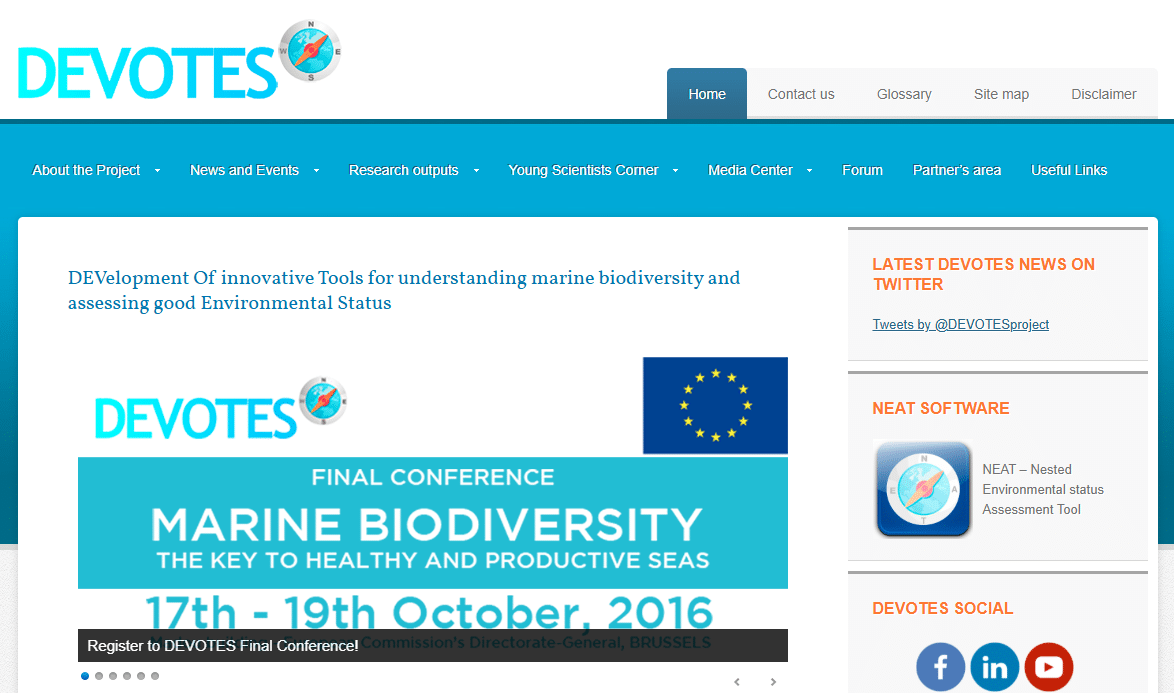
However, measuring “status” across highly complex, shifting marine environments has historically been hindered by mismatched monitoring frameworks and a lack of standardized diagnostic tools. The DEVOTES project was funded to solve this operational puzzle by building a unified suite of software, indicators, and modeling strategies tailored for European seas.
1. Project Profile
| Attribute | Details |
| Funding Framework | Seventh Framework Programme (FP7) – “Oceans of Tomorrow” |
| Grant Agreement ID | 308392 |
| Total Budget / Contribution | Approximately €12 million (EU contribution: €9 million) |
| Project Duration | November 2012 to October 2016 |
| Consortium Dynamics | 23 partners across 15 countries, including non-EU collaborators |
2. Project Scope: Deconstructing Marine Pressures
The primary ambition of DEVOTES was to bridge the persistent gap between complex marine science and actionable environmental policy. Its scope focused heavily on understanding the relationships between anthropogenic (human-induced) pressures, climate change, and their cumulative impacts on marine biodiversity.
Rather than looking at small localized spots, the project applied its frameworks across the four European Regional Seas:
- The Baltic Sea (governed by HELCOM)
- The North-East Atlantic Ocean (governed by OSPAR)
- The Mediterranean Sea (governed by the Barcelona Convention)
- The Black Sea (governed by the Bucharest Convention)
By examining these distinct environments through eight targeted case studies, the project mapped out how commercial fishing, pollution, eutrophication (nutrient over-enrichment), and maritime infrastructure collectively degrade seafloor integrity and disrupt marine food webs.
3. Key Deliverables & Practical Software
The legacy of DEVOTES rests on its software applications, indicator databases, and advanced monitoring methodologies designed directly for environmental managers.
NEAT (Nested Environmental Status Assessment Tool)
The crowning technological deliverable of the project is NEAT, a user-friendly desktop application built to calculate the environmental status of marine waters.
- The Problem It Solved: Traditional assessments often get skewed when a single bad indicator drowns out positive data, or when spatial scales don’t align.
- How It Works: NEAT utilizes a hierarchical, nested structure of Spatial Assessment Units (SAUs) and marine habitats. It normalizes distinct ecosystem data points and applies a weighted averaging procedure. This prevents any single indicator from introducing mathematical bias, allowing managers to obtain a true, holistic view of a sea basin’s health.
DEVOTool
To help researchers navigate the sea of environmental metrics, the project developed DEVOTool. This software application cataloged and evaluated greater than 600 marine biodiversity indicators currently utilized across Europe. It acts as a selection engine, allowing countries to identify which indicators are scientifically mature, cost-effective, and fully compliant with MSFD requirements.
Next-Generation Monitoring Protocols
DEVOTES successfully piloted and validated cutting-edge autonomous and autonomous data-acquisition techniques:
- Benthic Metagenomics: Transitioning from slow, manual microscopic sorting of seafloor organisms to high-throughput DNA metabarcoding to assess benthic community health.
- Advanced Remote Sensing & Acoustics: Implementing satellite tracking alongside acoustic array configurations to map habitat distributions without physically disrupting the seafloor.
4. Reporting & Environmental Impact
The final reporting cycles of DEVOTES completely changed how European institutions define and monitor ocean health.
True Harmonization
Before the project, neighboring countries sharing a single regional sea often used entirely different parameters to declare whether their waters were “healthy.” DEVOTES provided a synchronized classification scale where status results are clearly color-coded—ranging from High (Blue) and Good (Green) down to Poor (Orange) and Bad (Red). This unified language enabled transboundary marine planning for the first time.
Socio-Economic Realism
Through specialized work packages, the consortium conducted cost-benefit and cost-based assessments of marine monitoring programs. They established that investing in autonomous, high-tech tools (like biosensors and metagenetics) drastically reduces the long-term financial burden on member states while yielding higher-density data than traditional vessel-based sampling.
Scientific Foundations
With 177 open-access peer-reviewed scientific publications compiled in its repository, DEVOTES provided the structural definitions for terms like “Good Environmental Status” that were previously considered too abstract. Its recommendations directly guided the second implementation cycle of the MSFD, creating a permanent scientific footprint in global marine conservation policy.