Project Source & Documentation:
All official data, reporting summaries, and project outcomes cited in this article are derived directly from the European Commission’s CORDIS repository.
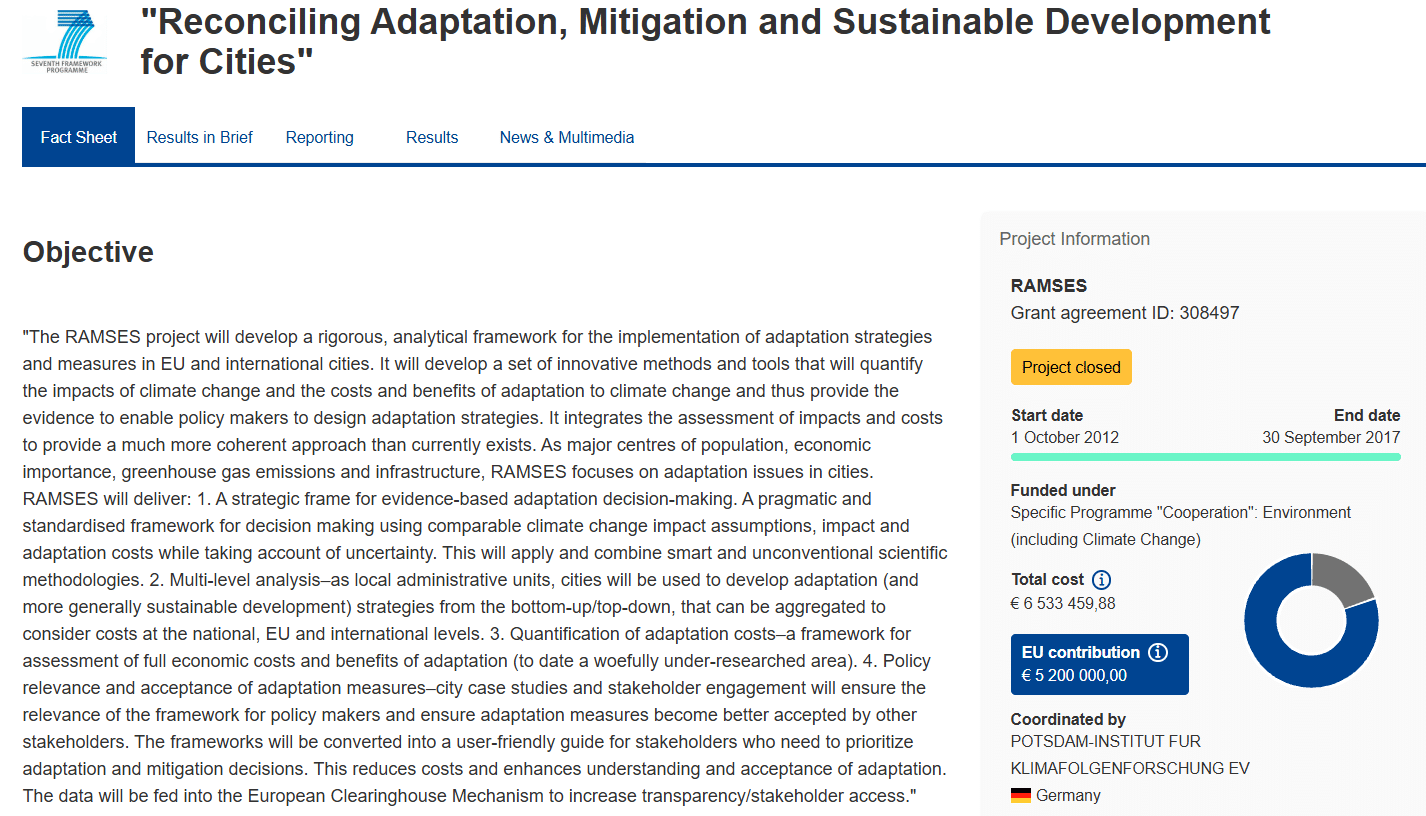
- Official Project Page:CORDIS Project ID 308497 – RAMSES
- CORDIS Article:Assessing the impact of climate change on cities
As more than 75% of the European Union’s population resides in urban environments—a figure projected to rise to over 82% by 2050—cities have become both the primary battlegrounds and the key centers of innovation for climate change action. To address these vulnerabilities, the European Union funded the ambitious RAMSES project (Reconciling Adaptation, Mitigation and Sustainable dEvelopment for citieS).
Operating under the broader thematic umbrella of sustainable land and resource management, RAMSES was designed to deliver much-needed quantified evidence regarding the impacts of climate change alongside the exact costs and benefits of scalable urban adaptation measures.
Project Overview & Administrative Reporting
The following reporting metrics highlight the financial scale, duration, and organizational framework of the RAMSES initiative as recorded in the European Commission’s project database:
| Reporting Parameter | Project Details |
| Project Acronym | RAMSES |
| Full Title | Reconciling Adaptation, Mitigation and Sustainable dEvelopment for citieS |
| Funding Programme | EU Seventh Framework Programme (FP7) |
| Topic Focus | ENV.6.2 (Sustainable use and management of land and seas) / ENV.2012.6.1-3 |
| Project Coordinator | Potsdam Institute for Climate Impact Research (PIK), Germany |
| Total Cost | €6,533,459.88 |
| EU Contribution | €5,200,000.00 |
| Project Lifecycle | October 1, 2012 – September 30, 2017 |
| Key Case Studies | 8 specific urban areas across Europe, India, North America, and South America |
The Core Scope: Reconciling Action and Economy
Prior to the RAMSES project, urban climate vulnerability assessments were largely bespoke, localized, and highly fragmented. Techniques and data structures varied so dramatically between cities that policymakers lacked a unified, comparable framework to prioritize investments.
RAMSES targeted this exact gap by combining top-down macro-modeling with bottom-up localized data. The primary objectives of its research scope included:
- Quantifying Urban Risks: Developing generic, transferable architectural and structural typologies for buildings and infrastructure based on specific climate threats (primarily extreme temperature/urban heat burdens, flooding, and windstorms).
- Balancing Mitigation & Adaptation: Investigating how structural choices (such as urban density, transport networks, and building insulation) inherently affect both carbon emissions (mitigation) and microclimate resilience (adaptation).
- Economic Cost-Benefit Validation: Building an analytical framework capable of calculating both the direct and indirect economic damage of climate inaction versus the long-term savings of nature-based and structural adaptation assets.
Key Deliverables and Project Outputs
Over its five-year lifecycle, the RAMSES consortium successfully synthesized complex environmental data into actionable, policy-relevant resources. The primary public deliverables include:
1. The Strategic Framing for Evidence-Based Adaptation
A standardized, pragmatic decision-making framework utilizing comparable climate change impact assumptions. This allowed cities to evaluate adaptation costs under consistent levels of uncertainty for the very first time.
2. Multi-Level Urban Analysis Models
Three advanced urban climate models were validated across international case-study cities. These models link surface water flood mapping, traffic flow sensor data, and land-use transformations directly to infrastructure disruption costs.
3. The City Stakeholder Toolbox
To bridge the gap between academic research and municipal deployment, the project converted its findings into an accessible, user-friendly digital suite:
- The Transition Handbook: A step-by-step practical guide for regional authorities to plan, fund, and maintain resilient infrastructure.
- Training Materials: Open-access modular resources designed to educate urban planners, architects, and municipal engineers.
- Audio-Visual Guidance Application: A dedicated, web-based platform (
on-urban-resilience.eu) highlighting interactive strategies for city infrastructure scaling.
4. Scientific Dissemination
The project generated a massive wave of academic validation, publishing 38 peer-reviewed journal articles (with numerous follow-ups in press) exploring everything from the mathematical relationship between power-law city density and emissions, to localized heat health thresholds.
Final Project Reporting and Strategic Impact
The final publishable summary report approved by the European Commission details a vital paradigm shift pioneered by RAMSES: urban climate resilience must move away from purely technical or single-axis cost-benefit analyses.
The reporting documents emphasize that city stakeholders do not benefit from a single “optimal path.” Instead, urban adaptation requires a diverse portfolio of decentralized options, where the empowerment of citizens and the deployment of localized nature-based solutions are central to increasing public acceptance.
By feeding its extensive granular data directly into the European Climate Adaptation Platform (Climate-ADAPT), RAMSES successfully provided the empirical evidence base required to reduce long-term structural adaptation costs, ensuring that European cities can transition into sustainable, low-carbon environments without sacrificing infrastructural stability or economic vitality.