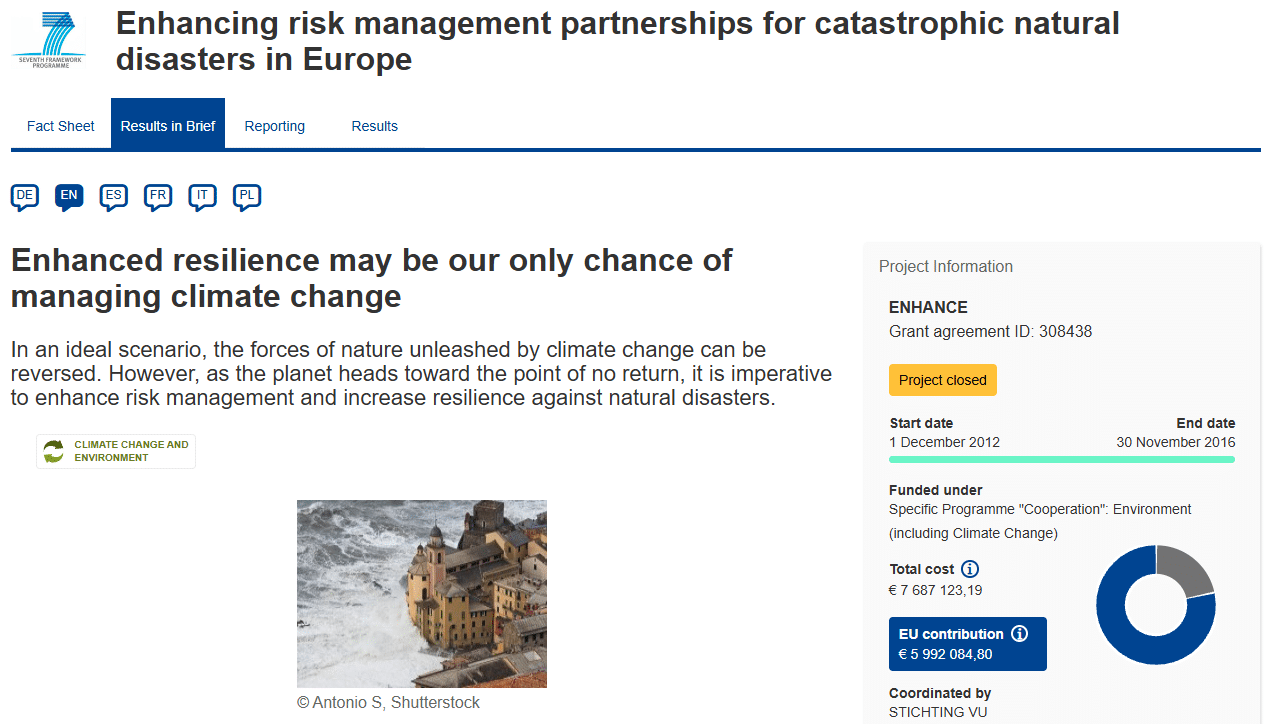
Featured Image: Click here to view the CORDIS ENHANCE Project Overview and Case Studies Graph
Project Citation Source: CORDIS Project Archive – European Commission (Grant ID: 308438)
Introduction
When a catastrophic natural disaster strikes—whether it is a sudden flash flood in Central Europe, a devastating wildfire in the Mediterranean, or a massive heatwave—the immediate roadblock to an effective response isn’t always a lack of data. More often than not, it is an institutional communication failure. Historically, public authorities, private corporations, insurance providers, and local communities have operated inside their own isolated silos, leaving gaps in preparation and response.
To break down these barriers, the European Union launched the ENHANCE project (“Enhancing risk management partnerships for catastrophic natural disasters in Europe”). Funded under the Seventh Framework Programme (FP7), this ambitious four-year initiative brought together 24 specialized partners from 11 European countries to completely rethink how society builds resilience against extreme weather events.
Project Scope: Breaking Silos via Multi-Sector Partnerships (MSPs)
The core scope of the ENHANCE project was to develop, test, and analyze innovative frameworks for Multi-Sector Partnerships (MSPs). Instead of relying solely on top-down government mandates, ENHANCE focused heavily on involving the financial and insurance sectors to share the burden of risk reduction and climate-proofing.
Rather than looking at natural hazards in a vacuum, the project deployed a holistic, multi-risk approach across a spectrum of catastrophic events:
- Hydrological & Meteorological Hazards: Inland floods, coastal storm surges, and severe droughts.
- Climatological & Terrestrial Hazards: Intense heatwaves, forest fires, and volcanic eruptions.
The methodology was entirely grounded in reality, utilizing 10 diverse case studies across different spatial scales in Europe. These included assessing the climate vulnerability of the Rotterdam harbour (Europe’s largest port), investigating forest fire resilience in the Mediterranean, and stress-testing the EU Solidarity Fund for macro-regional disasters in Romania and Eastern Europe.
Core Infrastructure & Key Deliverables
Coordinated by the Institute for Environmental Studies at VU University Amsterdam, the project translated complex climate and financial data into tangible assets for policymakers and private enterprises.
| Core Stream / Deliverable | Technical Functionality & Focus | Target End-Users |
| Dynamic Multi-Hazard Scenarios | Advanced probabilistic models using extreme value analysis to map out future vulnerabilities, asset exposure, and low-probability climate risks. | Regional Planners & Actuaries |
| The ENHANCE Toolbox | A centralized inventory of economic instruments, risk transfer schemes, and non-structural mitigation measures to increase societal resilience. | Public Authorities & Risk Managers |
| Operational MSP Guidelines | A set of participatory, tested frameworks defining how public agencies, private firms, and civil societies can successfully exchange empirical loss data. | Cross-sector Coalitions & NGOs |
| Global Policy Contributions | Direct, evidence-based policy recommendations delivered to EU entities and the UN Sendai Framework for Disaster Risk Reduction. | International Framework Signatories |
Project Reporting & Key Findings
The final reporting data from ENHANCE provided hard, empirical numbers that fundamentally changed how European institutions view the economics of climate adaptation.
“One of the most profound takeaways from the ENHANCE project is that risk management cannot rely on financial risk-transfer alone. Without active, physical risk reduction, the entire insurance ecosystem risks destabilization.”
The Critical Data Insights:
- The Power of Cooperation: The project proved that fully operational Multi-Sector Partnerships can significantly streamline risk mitigation strategies, reducing overall natural disaster risk by over 40%.
- The Hidden “Indirect” Toll: Traditional damage models usually only measure direct physical damage (like destroyed buildings). ENHANCE developed methods to trace indirect economic ripples through interconnected supply chains. They discovered that indirect damages in areas not directly hit by a disaster can account for up to 40% of the total economic loss.
- Activating the Household: By utilizing Agent-Based Models (ABMs) to simulate human behavior, the project found that targeting individual household actions through clearer risk communication and financial incentives (like smart insurance deductibles) can improve local risk reduction by up to 35%.
- The 120% Premium Warning: Project coordinator Jeroen Aerts issued a stark warning regarding financial viability: if European nations do not invest heavily in physical protection measures, flood insurance premiums in countries like France and Germany under the EU 2050 climate vision could skyrocket by up to 120%, making coverage entirely unaffordable for regular citizens.
By demonstrating that public-private cooperation can directly reduce both economic losses and physical vulnerabilities, the ENHANCE project established a vital blueprint for modern, multi-layered disaster risk governance in Europe.