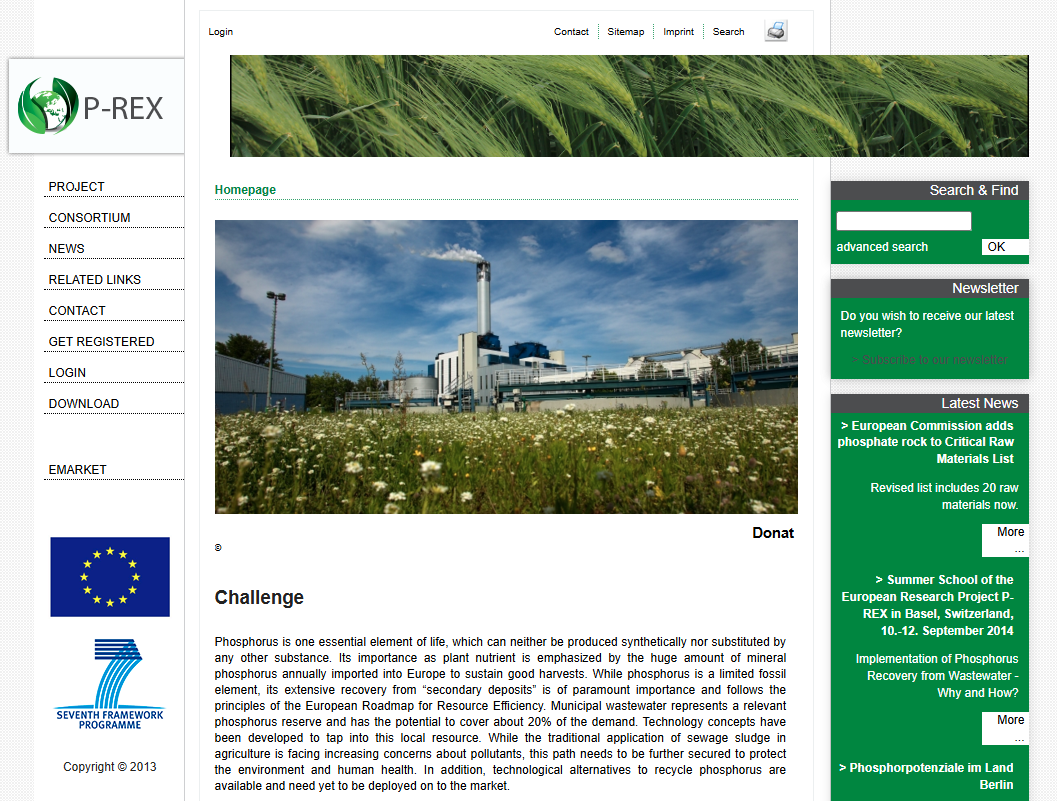
To keep agricultural soils fertile and sustain global crop yields, Europe relies on importing over one million tons of rock-mined mineral phosphorus every year. Yet, phosphorus is a finite, geopolitically vulnerable fossil resource. Paradoxically, massive quantities of this exact nutrient are discarded daily into municipal wastewater systems.
While raw sewage sludge has traditionally been spread directly onto agricultural land as a basic fertilizer, this practice faces increasing bans across EU member states due to rising concerns over heavy metals, microplastics, and pharmaceutical residues. The EU-funded P-REX project was launched to transition Europe away from this linear paradigm and unlock a secure, local, and toxic-free circular economy for nutrients.
The Project Scope: High-Volume, Systemic Nutrient Recovery
The fundamental goal of P-REX was to execute the first holistic, large-scale evaluation of technical phosphorus (P) recovery technologies using municipal sewage sludge and mono-incineration ashes. Instead of analyzing technologies in isolated laboratory settings, the project aimed to systematically validate these solutions under real-world, full-scale operating conditions.
The project targeted an ambitious goal: increasing Europe’s phosphorus recycling rate from municipal wastewater by up to 80%. To make this scalable, the scope of P-REX focused on three key systemic bottlenecks:
- Technological Comparison: Auditing and comparing competing chemical pathways for extracting phosphorus from the aqueous phase (sludge liquor), solid sewage sludge, and incinerated sludge ash.
- Market Disconnection: Bridging the deep market gap between wastewater treatment utilities (the suppliers of recovered materials) and the fertilizer manufacturing industry (the end-users).
- Policy Harmonization: Overcoming fragmented and contradictory national interpretations of environmental and waste-to-product legislation across Europe.
Key Project Deliverables
Rather than reinventing the wheel, P-REX synthesized fragmented academic data into practical, open-access resources designed to accelerate market adoption:
1. The P-REX Integral Guidance Document
This blueprint stands as a definitive handbook for municipal authorities and engineering consultants. It details the precise operating conditions, infrastructural prerequisites (such as Enhanced Biological Phosphorus Removal), and chemical input requirements needed to successfully integrate P-recovery units into existing wastewater treatment lines.
2. The Nutrient eMarket
In collaboration with the European Sustainable Phosphorus Platform (ESPP), the project launched an online, non-commercial matchmaking marketplace. The platform connects wastewater plant operators directly with regional agricultural entities, offering a clear channel for trading both unrefined raw materials and officially approved, processed recycled fertilizers.
3. Comprehensive LCA and LCC Frameworks
P-REX compiled exhaustive Life Cycle Assessment (LCA) and Life Cycle Costing (LCC) inventories using solid data derived from operational facilities. This allowed the consortium to quantify the exact carbon footprint offsets, energy balances, and economic payback periods of technical recovery versus conventional rock-mining extraction.
Field Reporting & Technology Performance Metrics
To help risk managers select the ideal installation setup for their specific regional constraints, P-REX analyzed full-scale validation data across three primary technical extraction routes:
| Extraction Pathway | Sample Process Evaluated | Phosphorus Recovery Potential | Plant Availability & P-Product Quality | Operational Trade-off |
| Aqueous Phase (Sludge Liquor) | AirPrex, Pearl, Struvia | Low to Moderate (~10–40% of incoming P mass flow) | Excellent. Precipitates high-purity struvite (magnesium ammonium phosphate) that acts as a highly effective, slow-release fertilizer. | Lowest capital cost and highly automated, but leaves the majority of the phosphorus trapped in the remaining sludge solid matrix. |
| Solid Sewage Sludge | Stuttgart process, Budenheim process | Moderate (~40–60% of incoming P mass flow) | Good. Utilizes acid or high-pressure carbon dioxide leaching to dissolve phosphates directly out of wet sludge. | High chemical consumption (acids/bases) increases operational costs and requires careful handling of volatile process steps. |
| Sewage Sludge Ash (SSA) | LeachPhos, EcoPhos, AshDec | High (~70–90% of incoming P mass flow) | Variable. Thermal and acid treatment is highly effective at destroying organic pollutants, but heavy metal separation requires precise, multi-stage filtration. | Captures the maximum amount of nutrients, but relies heavily on the availability of regional mono-incineration facilities to generate the raw ash. |
Key Performance Insight: A vital revelation from the project’s agronomic field trials was that standard laboratory water-solubility tests are highly unreliable for predicting how well a plant will absorb recycled phosphorus. Recycled products like struvite show lower water solubility but match conventional rock-based fertilizers in real-world crop yield performance because soil acids naturally release the nutrients exactly when the plant roots require them.