Project overview
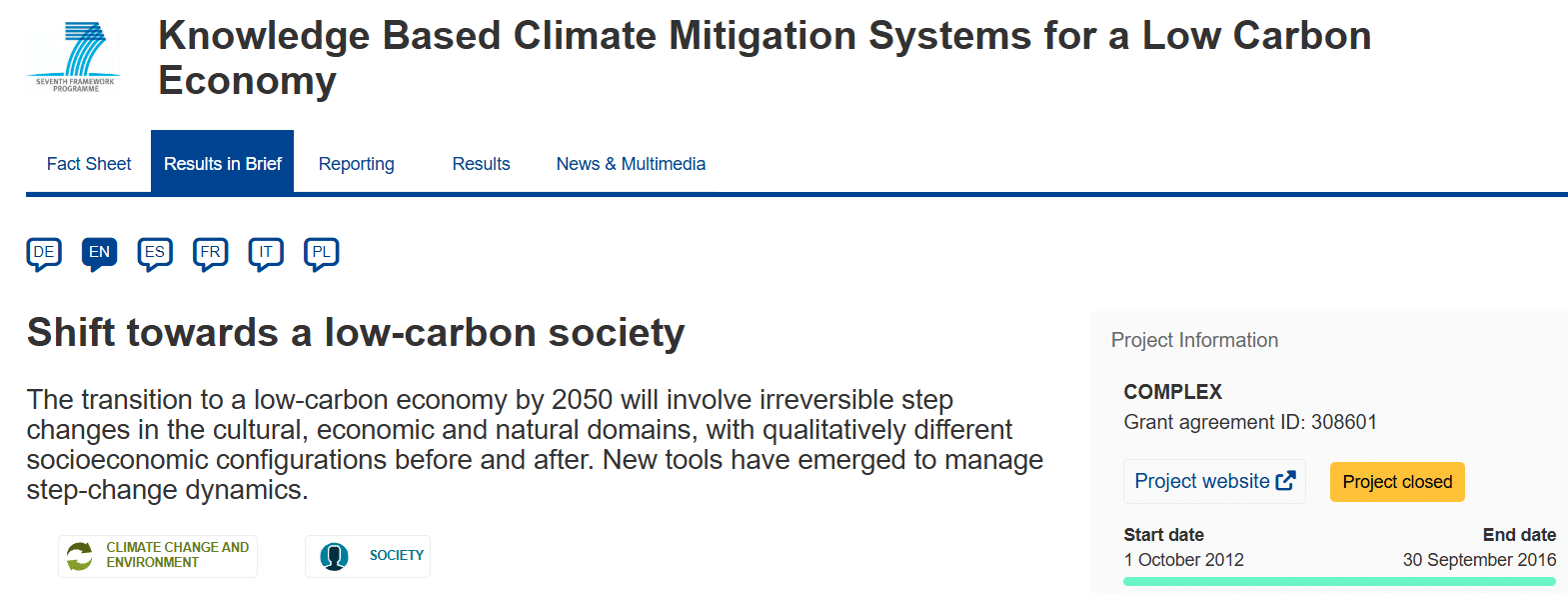
The EU-funded COMPLEX project explored how complex systems thinking can support climate mitigation and the transition to a low-carbon economy. It focused on how non-linear dynamics, thresholds, and cross-sector interactions shape long-term climate policy choices, especially at sub-national and regional levels.[cordis.europa]
The project brought together case studies in Norway, Sweden, the Netherlands, Spain, and Italy to build tools that help policymakers understand how climate mitigation strategies affect land use, energy, agriculture, forestry, and infrastructure over time.[cordis.europa]
Scope of the project
COMPLEX was designed to bridge scientific modelling and real-world policy planning. Its scope included developing a suite of modelling tools and decision-support systems that could help national and European stakeholders manage the transition to a low-carbon society by 2050.[cordis.europa]
A central idea was that climate mitigation cannot be treated as a single-sector problem. Instead, the project examined how policy measures interact across multiple scales, from local landscapes to national and supranational decision-making, and how those interactions influence acceptance and implementation.[cordis.europa]
Main deliverables
The project’s main deliverables can be grouped into three broad areas:
- Modelling tools. The consortium developed analytical tools that capture step-change dynamics and system-wide interactions relevant to climate mitigation.[cordis.europa]
- Decision-support systems. These systems were built to help policymakers assess long-term consequences of strategic choices under different climate scenarios.[cordis.europa]
- Policy analysis frameworks. The project produced approaches for studying acceptance, implementation, and realisation of climate mitigation policies at landscape and regional scales.[cordis.europa]
In practice, this meant creating a toolkit for analysing emerging land-use patterns, economic development, and the effects of policy instruments, while also linking short- and long-term processes that support decision-making at different governance levels.[cordis.europa]
Reporting style summary
For reporting purposes, COMPLEX can be described as a systems-oriented climate project that moved beyond linear planning. Its reports and results show that effective mitigation depends on understanding feedback loops, regional context, and stakeholder behaviour, not just emissions targets.[cordis.europa]
A concise reporting paragraph could read like this:
The COMPLEX project contributed to EU climate research by developing modelling tools and decision-support systems for the transition to a low-carbon economy. Through regional case studies and cross-sector analysis, it improved understanding of how land use, energy, agriculture, forestry, and infrastructure interact under different climate mitigation pathways.[cordis.europa]
Why it matters
COMPLEX is relevant because it addressed a core challenge in climate governance: policies often fail when they ignore complex interactions between sectors and time scales. By focusing on regional systems and stakeholder realities, the project helped inform more realistic and implementable low-carbon strategies across Europe.[cordis.europa]
Its value also lies in the type of knowledge it produced. The project supports not only climate modelling, but also practical policy design, helping communities and institutions move from abstract mitigation goals to actionable transition pathways.[cordis.europa]
Source link
Project fact sheet on CORDIS: COMPLEX – Knowledge Based Climate Mitigation Systems for a Low Carbon Economy[cordis.europa]