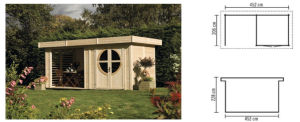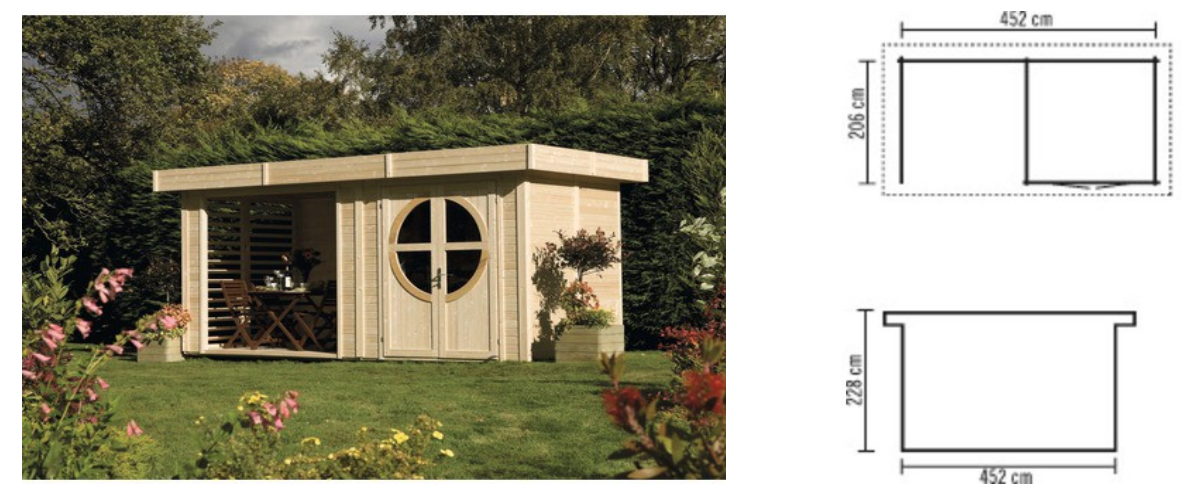
For this variant, we conducted a national and regional market study. A number of hypermarket suppliers of building and DIY materials offer such solutions, including Dedeman, Hornbach and even Emag, partially comparable on compari.ro. Separately, a number of private manufacturers and distributors offer, at least theoretically/virtually (on the internet), various other models. Although relatively different in shape and size, these products, generally called “garden houses”, have four main features in common, two of which are advantageous while the third constitutes a major disadvantage.
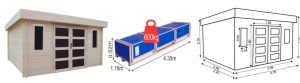
1. It is an extremely portable variant. It is purchased as a KIT and assembled on site, either by the supplier, upon request and for a fee, or by the DIY – Do It Yourself customer, like IKEA furniture. A single package/parcel is delivered, as in the example below Favernay (Emag), possibly brought with a 3.5-ton van. They are removable and easy to place elsewhere.
Two arguments in favor of purchasing such modules are the fact that they are made of natural wood and that they are light, so they can be placed on a simple concrete or even ballasted platform or on a wooden frame supported on burned or bituminized wooden piles, or on stone slabs/simple paving. 3. They are insufficiently insulated for the cold months (October-April).
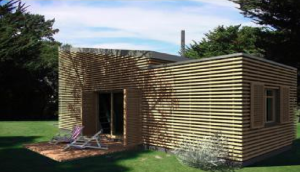
Most commercial solutions are made of a single layer of 30-40mm thick slatted wood mounted with tongue and groove and a structure on wooden frames of approximately 40x80mm or 50x100mm. More complex variants are sandwich-type solutions, as in the image below, with insulation in the middle, but which significantly reduce the space (while maintaining the original dimensions) without making the modules completely usable even in winter. A possible envelope, in addition to the facades of the vegetation layers and experimental layers, will further complicate the structural system, which is not designed for this purpose, which is why the variant designed from 0 is more appropriate.