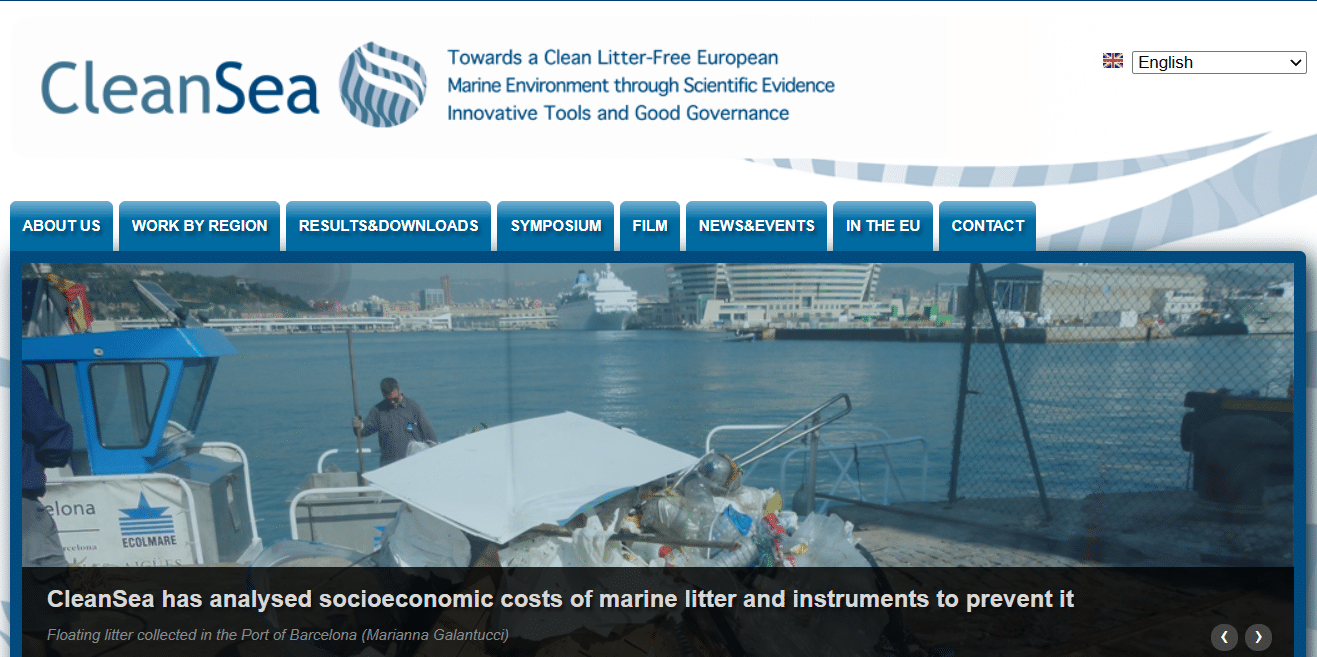
Source:CLEANSEA CORDIS Fact Sheet|Marine Strategy Framework Directive – CleanSea Profile
Marine litter—especially plastic waste—presents one of the most visible and complex threats to the global ocean. Beyond the aesthetic degradation of our coastlines, the true hazard lies beneath the surface, where macro-debris fractures into pervasive microplastics. These tiny particles infiltrate marine food webs, absorb chemical pollutants, and impact ecosystems in ways science is only beginning to fully quantify.
As the first-ever EU framework research project dedicated purely to marine litter, CLEANSEA was launched to build a robust scientific foundation for action. By combining ecotoxicology, oceanographic modeling, satellite imaging, and institutional analysis, the project set out to provide European decision-makers with the tools and evidence needed to achieve a litter-free marine environment.
1. Project Profile
| Attribute | Details |
| Funding Framework | Seventh Framework Programme (FP7) |
| Grant Agreement ID | 308370 |
| Interdisciplinary Scope | 11 European countries spanning all 4 regional seas |
| Consortium Structure | Top-tier academic research groups joined by 6 innovative SMEs |
| Primary Directive Alignment | Marine Strategy Framework Directive (MSFD) Descriptor 10 (Marine Litter) |
2. Project Scope: An Interdisciplinary Deep Dive
The CLEANSEA project approached the marine litter crisis through a 360-degree lens, recognizing that an environmental issue cannot be solved without addressing its economic, technological, and political drivers.
Its research footprint covered Europe’s four main marine regions: the Mediterranean Sea, the Black Sea, the Baltic Sea, and the North-East Atlantic Ocean.
The scope was built around three pillars:
- Scientific Evidence: Investigating the biological and toxicological impacts of litter on marine organisms. This meant mapping out exactly where macro-plastics accumulate and how they break down into microplastics in surface waters, sediments, and marine tissues.
- Innovative Tools: Developing low-cost, high-efficiency sampling technologies and hydrodynamic models to track how trash drifts across transboundary waters.
- Good Governance: Analyzing the institutional, financial, and behavioral barriers preventing member states from reaching Good Environmental Status (GES).
3. Key Deliverables
CLEANSEA successfully translated field data into functional toolkits, hardware, and policy roadmaps designed to modernize waste tracking and management.
- Advanced Microplastic Sampler: The project engineered, prototyped, and field-tested a novel microplastic sampler capable of efficiently gathering small particles from surface layers and the seabed.
- Plastic Fragmentation & Hydrodynamic Models: By applying advanced numerical circulation models to particle tracking, the team generated predictive simulations showing how plastic fragments migrate, sink, or beach over time.
- Ecosystem Services Mapping & Database: A specialized economic registry that catalogs the hidden socio-economic costs of marine litter, measuring its direct financial toll on tourism, shipping navigation, and commercial fisheries.
- The European Marine Litter Roadmap: A policy master blueprint offering clear, step-by-step strategies for reducing marine waste at the source through improved recycling, circular design paradigms, and updated upstream production.
4. Reporting & Environmental Outcomes
The final reporting from the CLEANSEA consortium delivered critical baseline data that permanently shifted how marine pollution is monitored across the European Union.
Hard Data on Microplastic Distribution
The project successfully quantified microplastic concentrations across previously unmapped marine baselines. By assessing microplastics concurrently in seabed sediments, water columns, and animal tissues, researchers provided definitive proof of how deeply synthetic materials have integrated into benthic habitats.
“Fishing for Litter” Integration
Collaborating closely with regional networks like KIMO, CLEANSEA collected and analyzed geo-labeled waste caught by commercial fishing vessels. Over 400 fishermen across dozens of crews used specialized big-bags to haul up hundreds of tons of seabed litter. This real-world trash was then sorted and mapped against OSPAR criteria, providing an accurate spatial view of marine waste accumulation zones in the North Sea.
Breaking Governance Barriers
Through a series of stakeholder platforms, the project pinpointed exactly why previous anti-littering policies failed. It revealed that fragmented coordination between maritime authorities, inland river managers, and waste disposal facilities created structural gaps. CLEANSEA’s institutional analysis provided concrete governance adjustments later integrated into the EU’s Circular Economy Action Plan and the Waste Framework Directive.
Supporting Public Awareness
To ensure the science reached beyond academic journals, the project produced an award-winning documentary film and a traveling educational exhibition. These initiatives visualised the hidden impacts of microplastics for the public, building the widespread societal momentum that eventually paved the way for subsequent single-use plastic restrictions across Europe.